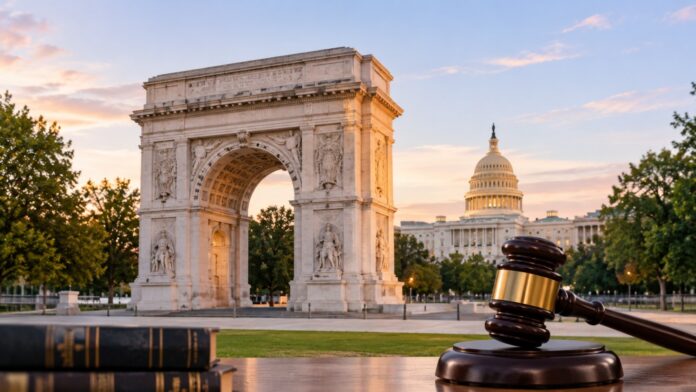
Story Highlights
- U.S. District Judge Tanya Chutkan issued a 14-day temporary restraining order halting construction on President Trump’s proposed memorial arch
- The National Capital Planning Commission had approved the 250-foot structure in an 8-4 vote Thursday evening after a nine-hour hearing
- The arch project faces legal challenges despite administration approval and Interior Department authorization
- The memorial is intended as part of the administration’s broader effort to reshape Washington’s iconic landscape
What Happened
A federal judge issued a temporary restraining order Friday morning that prevents the Trump administration from beginning construction on its ambitious memorial arch near downtown Washington. The decision by U.S. District Judge Tanya Chutkan imposed a 14-day halt on the project, delivering an unexpected setback just hours after the National Capital Planning Commission had voted to grant final approval for the structure.
The National Capital Planning Commission’s approval on Thursday evening came after an extended nine-and-a-half-hour hearing that featured extensive testimony from opponents of the project. The commission voted 8-4 in favor of moving forward with the 250-foot-high arch, which the administration indicated could have begun construction within days. The Interior Department had already issued its final authorization for the project, and the National Park Service had published the required notifications to proceed.
- U.S. District Judge Tanya Chutkan issued the temporary restraining order on Friday
- National Capital Planning Commission voted 8-4 to approve the arch Thursday evening
- The nine-hour hearing included numerous witnesses testifying in opposition
- Interior Department had finalized authorization prior to the judge’s ruling
Why It Matters
The judicial intervention represents a significant complication for one of the administration’s most prominent architectural initiatives in its vision to transform the nation’s capital. The temporary halt delays what the White House had positioned as a major achievement in commemorating American history and honoring veterans. The 14-day restraining order provides time for legal challenges to proceed through the courts, potentially extending the timeline for the project considerably.
The blocking of the project demonstrates how federal courts continue to serve as a check on executive branch initiatives, even when regulatory agencies have completed their approval processes. The ruling raises questions about the ultimate trajectory of the memorial, as legal opponents have mounted objections centered on concerns about impacts to the nearby Arlington National Cemetery and the visual landscape of Washington.
- The halt delays a significant administration priority in remaking Washington’s architecture
- The ruling allows legal challenges to proceed through the court system
- The decision demonstrates ongoing judicial oversight of executive branch projects
- Questions remain about the project’s final approval and construction timeline
Political and Public Context
The memorial arch project reflects the administration’s broader agenda to reshape Washington and commemorate the nation’s 250th anniversary. Commission chairman Mark Paoletta, a Trump appointee who also serves as general counsel for the White House Office of Management and Budget, opened the Thursday hearing with remarks praising the proposal. He noted that great cities around the world have iconic arches—referencing Paris, Rome, and London—and characterized the president’s support for the project as reflecting an understanding of national identity and architectural significance.
Opposition to the arch has centered on concerns about its proximity to Arlington National Cemetery and its potential visual impact on the sacred ground where hundreds of thousands of military personnel are buried. The nine-hour hearing drew dozens of witnesses who expressed concerns about the memorial’s effects on the solemnity and visual integrity of the cemetery. The National Capital Planning Commission’s vote split along lines reflecting federal and local interests, with administration-connected members voting in favor while representatives of the District of Columbia opposed the project.
- The project is part of efforts to commemorate America’s 250th anniversary
- Opposition focuses on impacts to Arlington National Cemetery and its surroundings
- Commission chairman Paoletta cited examples of famous arches in other world capitals
- The planning commission vote reflected divisions between federal and local interests
Trump Obsesses Over Triumphal Arch After Judge Blocks Construction https://t.co/BFH2RKBJcy
— The New Republic (@newrepublic) November 6, 2026
What Happens Next
The 14-day restraining order provides a window during which legal proceedings are expected to advance. During this period, the courts will likely consider whether to extend the temporary halt or permit construction to proceed. The administration will need to respond to the legal challenges and potentially present additional arguments for why the project should move forward despite judicial concerns.
Beyond the immediate restraining order, the project faces an uncertain path through the federal court system. Questions also remain unanswered regarding the precise funding mechanism and final cost estimates for the structure, with some projections reaching as high as $100 million. The outcome of the legal proceedings could determine whether the administration’s vision for this memorial ultimately becomes reality or faces permanent barriers to construction.
- The 14-day restraining order provides time for legal proceedings to advance
- Courts will determine whether to extend the halt or permit construction
- Funding mechanism and final costs remain to be clarified
- The project’s ultimate fate will depend on the resolution of legal challenges