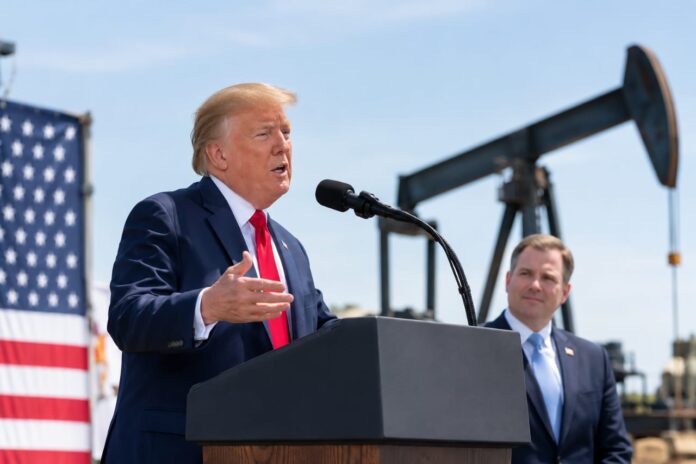
Story Highlights
- President Trump announced plans to loosen methane regulations for the oil and gas sector during a rally in Lubbock, Texas on Tuesday night
- The administration expects the rollback to save the industry approximately $45 billion while enabling an additional 210 million barrels of oil production through 2050
- Changes include relaxed rules for marginal wells, easing restrictions on gas flaring, and elimination of the Super Emitter Program that tracked major methane leaks
- The White House framed the deregulation as a necessary step to boost energy independence and economic growth in the oil-heavy state
What Happened
During his second campaign stop in Texas on Tuesday night, President Trump announced his administration’s intention to roll back Biden-era methane regulations affecting the oil and gas industry. The announcement came as part of a broader push to support Republican Senate candidates in the energy-rich state. Environmental Protection Agency Administrator Lee Zeldin has been working with the White House on this regulatory rollback for an extended period, according to administration officials.
The proposed changes represent a significant shift in how the federal government will regulate methane emissions from energy production. The administration outlined several specific modifications to existing rules that would fundamentally alter compliance requirements across the sector.
- Lubbock, Texas rally on Tuesday night featured President Trump announcing the methane deregulation proposal
- EPA Administrator Lee Zeldin has been coordinating the regulatory rollback process with the White House for a considerable time
- The proposal would loosen standards governing how oil and gas companies manage methane, a greenhouse gas approximately 28 times more potent than carbon dioxide
- Changes target marginal wells, gas flaring practices, and elimination of leak-detection requirements
Why It Matters
The regulatory changes carry substantial economic and environmental implications for both the energy sector and the nation’s climate trajectory. By loosening methane standards, the administration is prioritizing economic growth and energy independence over emissions reduction, a policy direction that aligns with its pro-business regulatory philosophy. Industry analysts expect the modifications will substantially reduce compliance costs while increasing production capacity, making marginal operations economically viable that might otherwise face closure.
The specific changes outlined in the proposal address key cost drivers within the sector. Relaxed standards for marginal wells—which produce relatively small quantities of oil but account for roughly half of the sector’s methane emissions—will lower operating expenses for smaller producers. Easing restrictions on flaring, the controlled burning of excess natural gas during oil extraction, removes another significant compliance burden. The elimination of the Super Emitter Program, which required companies to respond to credible reports of major methane leaks, streamlines regulatory oversight and reduces monitoring obligations.
Economic benefits to industry players are substantial. The administration estimates that the rollback could save the oil and gas sector approximately $45 billion. Additionally, the regulatory environment is expected to unlock additional petroleum and natural gas production, with projections indicating an additional 210 million barrels of oil and 1.41 trillion cubic feet of natural gas could be extracted between 2027 and 2050. To place this in perspective, the projected additional oil production equals roughly ten days’ worth of current U.S. consumption, while the natural gas component represents approximately fifteen days of domestic usage at current rates.
- Oil and gas industry stands to save approximately $45 billion through reduced compliance costs
- Additional 210 million barrels of oil production projected between 2027 and 2050, equivalent to ten days of U.S. consumption
- Marginal well producers will benefit most from loosened standards, as these currently unprofitable operations become economically feasible
- Environmental groups will likely contest the rollback, citing potential climate impact and loss of emissions reduction achieved under previous administration
Political and Public Context
The methane deregulation announcement occurs within a broader Trump administration strategy to maximize domestic energy production and reduce regulatory burdens on fossil fuel industries. This approach reflects the president’s commitment to fossil fuel development as central to American economic and energy policy. The timing of the announcement during a Texas rally, where energy represents a critical economic driver, underscores the political significance of the proposal and its importance to key Republican constituencies.
The previous administration implemented tighter methane standards in 2023, claiming that these regulations would prevent 58 million tons of methane emissions between 2024 and 2038—equivalent to removing 28 million gasoline-powered vehicles from roadways for one year. The current rollback reverses this environmental calculation, prioritizing industrial competitiveness and domestic energy output over emissions reduction targets. This represents a fundamental philosophical disagreement about the proper balance between environmental regulation and economic productivity, a debate that has characterized energy policy discussions between the two administrations.
- Previous administration’s 2023 methane rules aimed to prevent 58 million tons of emissions through 2038
- Texas remains central to Republican political strategy, with energy policy closely tied to state economic interests
- EPA Administrator Lee Zeldin has championed deregulation efforts as part of broader White House pro-growth agenda
- Methane regulation has become a polarizing issue between administrations with differing priorities on climate versus energy production
Trump announces proposal to loosen methane rules for oil and gas productionhttps://t.co/BEavQXBKGl
— The Hill (@thehill) October 28, 2026
What Happens Next
The regulatory changes now move through the formal rulemaking process, during which the administration will publish its proposals in the Federal Register and accept public comments before final implementation. This procedural phase typically spans several months and allows for legal challenges and stakeholder input. Environmental groups are expected to mount aggressive opposition, potentially including litigation challenging the rollback as violating environmental law requirements.
The proposal will likely become a focal point in ongoing debates about energy policy and climate strategy. Congressional Democrats and environmental advocates will probably mobilize to challenge the administration’s approach, though without control of Congress, their options remain limited. Industry players, conversely, are anticipated to accelerate planning for increased production under the looser regulatory framework, particularly operators of marginal wells that become newly profitable.
- Formal rulemaking process will begin with Federal Register publication and public comment period
- Environmental organizations expected to challenge rollback through litigation and legislative advocacy
- Marginal well operators will likely accelerate production planning based on newly favorable regulatory environment
- Implementation timeline and final regulatory language remain subject to administrative and potentially judicial review