Story Highlights
- The White House launched the Genesis Mission, securing $2.4 billion in private sector AI commitments from major technology companies
- President Trump awarded the National Medal of Science to tech leaders including Elon Musk, Sergey Brin, Jensen Huang, and Lisa Su
- The administration is shifting scientific advancement toward private-sector partnerships while reducing federal research funding
- The Genesis Mission aims to unite Department of Energy labs with industry and academia for breakthroughs in energy dominance and national security
What Happened
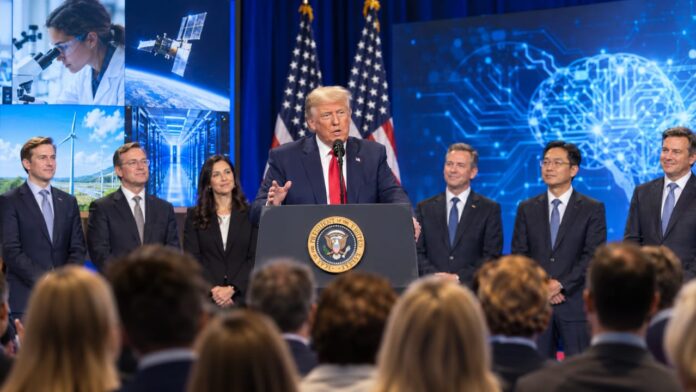
The White House convened a Science: A New Golden Age summit on October 8, 2026, where President Trump unveiled a major strategic pivot toward artificial intelligence-driven scientific advancement. During the event, his administration announced that leading technology firms had committed more than $2.4 billion to the Genesis Mission, an initiative designed to accelerate American research and development through AI innovation. The president emphasized America’s historical leadership in transformative technologies, from electricity and aviation to computing and the internet, underscoring his commitment to maintaining technological dominance on the global stage.
The Genesis Mission represents an expansion of an executive order the president had previously issued in November 2025. The initiative brings together Department of Energy laboratories with private industry, academic institutions, and other partners to harness artificial intelligence for discoveries in energy security, scientific breakthroughs, and national security applications. This public-private partnership model represents a fundamental reshaping of how the nation approaches scientific research and development in the age of advanced computing.
- Participating companies include OpenAI, Anthropic, xAI, Palantir, and Amazon, collectively pledging $2.4 billion
- Medal recipients included Elon Musk, Sergey Brin, Jensen Huang, and Lisa Su, along with technology innovation awards for Satya Nadella and Michael Dell
- The Genesis Mission links federal Department of Energy resources with private sector capabilities for collaborative research
- October 8, 2026 was the date of the summit announcement at the US Institute of Peace in Washington, D.C.
Why It Matters
This strategic shift represents a significant departure from traditional models of federally-funded scientific research. By leveraging private sector investment and artificial intelligence capabilities, the administration is attempting to accelerate scientific progress while reducing reliance on traditional government research budgets. The approach reflects confidence in market-driven innovation and the technological prowess of leading American companies to advance the nation’s scientific agenda. The $2.4 billion private commitment demonstrates substantial corporate confidence in AI-powered research methodologies and their potential to generate breakthrough discoveries that serve both commercial and national security interests.
The emphasis on artificial intelligence as a research accelerant aligns with broader economic trends favoring computational methods and machine learning applications across scientific disciplines. By concentrating resources on AI-powered research partnerships, the administration is positioning the United States to maintain competitive advantages in energy technology, materials science, and other critical fields. This model potentially allows for faster iteration cycles and more efficient resource allocation than traditional bureaucratic research funding mechanisms. The recognition of technology leaders through prestigious national medals underscores the administration’s view that private innovation, not government institutions, represents the future of American scientific advancement.
- Private sector investment reduces dependency on congressional appropriations for scientific research
- AI-driven research methodologies could accelerate discovery timelines in energy, materials science, and national security applications
- Department of Energy laboratories gain access to cutting-edge computational resources and technical expertise from leading technology firms
- The partnership model may redirect research priorities toward commercially viable and strategically important applications
Political and Public Context
The Genesis Mission announcement arrives amid broader policy discussions about the federal government’s role in scientific funding. The administration has pursued a streamlined approach to federal spending across multiple agencies, redirecting resources toward what it views as strategic priorities. The recognition of technology entrepreneurs and corporate leaders reflects the administration’s philosophy that innovation thrives in competitive markets rather than government-managed research centers. This perspective aligns with longstanding conservative critiques of federal bureaucracy and arguments that private enterprise delivers results more efficiently than government agencies.
The timing of the summit and the awards ceremony demonstrates coordinated messaging around a comprehensive vision for American scientific leadership. Each of the honored technology leaders has established significant contributions to American innovation, from space exploration and artificial intelligence development to semiconductor manufacturing and cloud computing infrastructure. The National Medal of Science and National Medal of Technology represent the nation’s highest recognition for scientific and technological achievement, making their presentation a significant symbolic endorsement of the private sector’s role in advancing national interests. The administration’s elevation of these corporate leaders sends a clear signal about which entities it views as driving American scientific progress in the twenty-first century.
- The awards recognize Elon Musk, Sergey Brin, Jensen Huang, Lisa Su, Satya Nadella, and Michael Dell for technological leadership
- Previous initiatives including the November 2025 executive order established the framework for this expanded public-private research model
- Conservative policy advocates have long argued for reduced federal research bureaucracy in favor of market-driven innovation
- The Genesis Mission represents one of the largest coordinated private sector commitments to government-affiliated research infrastructure
Trump unveils $2.4B investment from tech giants including Nvidia, OpenAI to fund federal AI mission https://t.co/J3u4SL7o6i pic.twitter.com/KLOFwgpGnR
— New York Post (@nypost) October 8, 2026
What Happens Next
The Genesis Mission’s implementation will likely proceed through 2027 and beyond, with participating companies establishing collaborative research teams and integrating artificial intelligence tools into Department of Energy facilities. The administration may announce additional corporate participants and expanded funding commitments as the initiative gains momentum. Federal agencies will need to establish governance structures and intellectual property frameworks that balance private sector interests with public research objectives. The success or challenges encountered in this partnership model could influence broader policy decisions about federal scientific funding architecture.
Congress may address questions about oversight mechanisms, data security, and the balance between proprietary research interests and public benefit in these collaborative arrangements. Future announcements could expand the Genesis Mission to include other federal research agencies beyond the Department of Energy, potentially reshaping how the National Institutes of Health, NASA, and other scientific institutions conduct research. The effectiveness of AI in accelerating scientific discoveries will become clearer as specific research projects produce results, potentially validating or challenging the assumptions underlying this public-private model. Technology industry participation levels and continued corporate funding commitments will serve as indicators of whether this approach achieves its intended outcomes.
- Implementation of AI research protocols across Department of Energy laboratories expected throughout 2027
- Potential expansion of the Genesis Mission to additional federal agencies and research institutions
- Congress may develop oversight legislation addressing intellectual property rights and research data ownership
- Results from early AI-accelerated research projects will determine whether the model warrants further expansion or modification