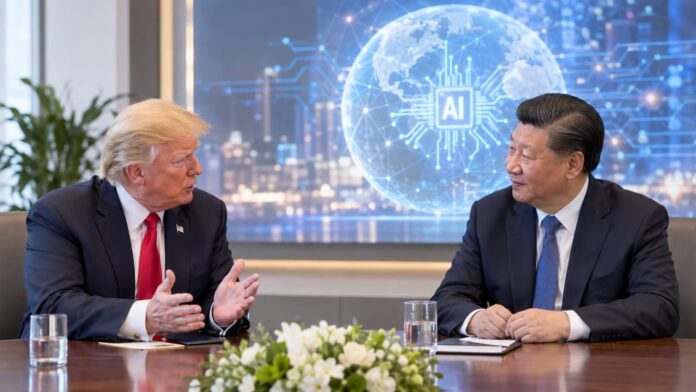
Story Highlights
- President Trump dismisses fears surrounding AI, calling them exaggerated and politically motivated.
- The upcoming summit with Xi Jinping presents a crucial opportunity for US-China cooperation on AI regulation.
- Rapid advancements in AI technology raise urgent questions about safety and ethical considerations.
- Industry leaders express concerns, but Trump emphasizes American leadership and innovation.
What Happened
In a bold move that has ignited discussions worldwide, President Trump has taken a firm stance on artificial intelligence (AI), asserting that the fears surrounding its development are largely unfounded. As the world watches, the upcoming summit between Trump and Chinese President Xi Jinping is poised to address the pressing need for international cooperation in regulating AI technology. This summit is not just a meeting of two leaders; it represents a pivotal moment in shaping the future of AI and its implications for global society.
Trump’s comments come in the wake of alarming warnings from tech industry leaders about the rapid pace of AI advancements. Recently, Jacob Coxon, a researcher at Anthropic, resigned due to concerns that AI could pose a significant threat to humanity. His resignation, along with similar sentiments from other prominent figures in the tech world, has raised alarms about the unregulated competition between technology companies, particularly between the US and China. The president, however, has dismissed these concerns as exaggerated, suggesting that they serve a political agenda rather than a genuine fear for public safety.
- Jacob Coxon resigns from Anthropic over AI concerns.
- Trump labels AI fears as a ‘hoax’ and politically motivated.
- Upcoming summit with Xi Jinping set for this week.
- Industry leaders, including Sam Altman and Elon Musk, call for a slowdown in AI development.
Why It Matters
The implications of Trump’s stance on AI are profound. By rejecting the notion that AI poses an existential threat, he is advocating for a more aggressive approach to technological innovation. This perspective aligns with his administration’s broader agenda of promoting American leadership in technology and innovation. The urgency for a collaborative framework between the US and China becomes increasingly clear, as both nations are at the forefront of AI development. A strong partnership could not only mitigate risks but also harness AI’s potential for global benefit, steering humanity towards a safer technological future.
Moreover, the president’s confidence in American capabilities suggests a belief that the US can lead the way in establishing ethical guidelines and safety measures for AI without stifling innovation. This approach could foster an environment where technological advancements are pursued responsibly, ensuring that the benefits of AI are maximized while minimizing potential risks. The consequences of failing to address these issues could be dire, affecting not only the tech industry but also the broader global community.
- Potential for US-China cooperation on AI regulation.
- Risk of unregulated AI development leading to unforeseen consequences.
- Impact on global technological leadership and innovation.
- Public perception of AI and its implications for society.
Political and Public Context
Understanding the context of this debate is crucial. The rapid advancements in AI technology have outpaced regulatory frameworks, leaving governments and industries scrambling to catch up. Historically, technological revolutions have often been met with skepticism and fear, but they have also led to significant societal advancements. The current situation mirrors past technological shifts, where the benefits of innovation were often overshadowed by fears of the unknown.
In recent years, AI capabilities have been doubling at an unprecedented rate, with generative AI technology advancing rapidly. This has led to a growing chorus of voices calling for caution and regulation. However, Trump’s administration has consistently emphasized the importance of maintaining a competitive edge in technology, arguing that excessive regulation could hinder progress. The upcoming summit with Xi Jinping presents an opportunity to address these concerns collaboratively, potentially setting a precedent for future international cooperation on technology regulation.
- Historical context of technological revolutions and public perception.
- Rapid advancements in AI capabilities and their implications.
- Previous international agreements on technology regulation.
- Trump’s administration’s focus on maintaining a competitive edge in technology.
Trump says DOJ will rein in AI 'if we have to' – President Trump has touted development of artificial intelligence by U.S. companies as a competitive advantage over China that he wants to maintain. Via @CNBC:https://t.co/DtgO29GCJj
— 🌊💙 Viking Resistance 💙🌊 (@BlueCrewViking) September 21, 2026
What Happens Next
As the summit approaches, the world is left wondering what the future holds for AI regulation and international cooperation. The discussions between Trump and Xi will likely focus on establishing a framework that balances innovation with safety. This could involve creating guidelines for ethical AI development, sharing best practices, and fostering collaboration between tech companies in both nations.
Moreover, the outcome of this summit could have far-reaching implications for the global tech landscape. If the US and China can come to an agreement on AI regulation, it may set a standard for other countries to follow. Conversely, failure to reach a consensus could lead to increased tensions and competition, further complicating the already fraught relationship between the two superpowers.
- Potential establishment of international guidelines for AI development.
- Impact on global tech industry and innovation.
- Possibility of increased tensions if no agreement is reached.
- Future discussions on ethical considerations in AI technology.