Story Highlights
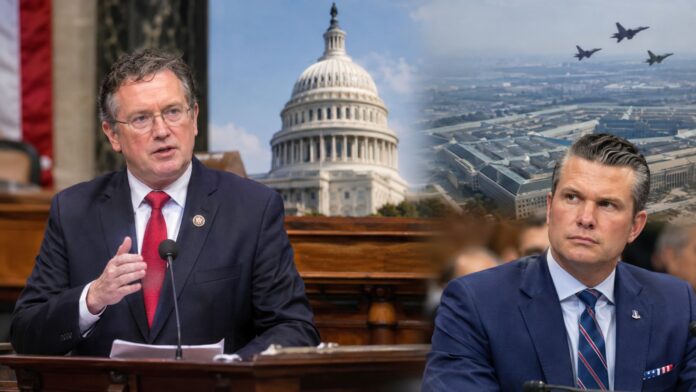
- Rep. Thomas Massie introduces articles of impeachment against Secretary of Defense Pete Hegseth.
- The impeachment articles focus on military actions in Iran without congressional authorization.
- This move highlights divisions within the GOP regarding war powers and military engagement.
- Massie’s actions could impact the political landscape for several Republican lawmakers facing reelection.
What Happened
On Tuesday, Rep. Thomas Massie, a Republican from Kentucky, made headlines by introducing articles of impeachment against Secretary of Defense Pete Hegseth. This bold move comes in the wake of ongoing military operations in Iran that have been conducted without the necessary congressional authorization. Massie, who serves on the Judiciary Committee, has taken a significant step by introducing the measure as privileged, which means it will require the House to address the resolution, even though it is unlikely to pass in the current Trump-controlled House of Representatives.
This maneuver is particularly noteworthy as it forces GOP lawmakers to publicly declare their stance on Hegseth’s management of military operations. The implications of this action are profound, as it places pressure on Republican representatives who may have previously aligned with Massie and Democrats in voting for measures aimed at curbing the president’s war powers. The political ramifications could be significant, especially for those facing competitive reelection contests in the upcoming November elections.
- Massie introduced the impeachment articles on September 15, 2026.
- He accused Hegseth of violating the War Powers Resolution of 1973.
- Massie’s resolution is seen as a challenge to the Trump administration’s military strategy.
- Reps. Brian Fitzpatrick and Tom Barrett are among those facing tough reelection battles.
Why It Matters
The introduction of impeachment articles against Hegseth is a pivotal moment for the Republican Party, as it underscores the growing divisions within the GOP regarding military engagement and the limits of executive power. The president’s administration has been characterized by a robust military strategy, particularly in the Middle East, which has garnered both support and criticism from various factions within the party. Massie’s actions compel lawmakers to confront their positions on war powers, a topic that has become increasingly contentious in recent years.
For many Republicans, the issue of military engagement is not just a matter of policy but also one of principle. The War Powers Resolution of 1973 was enacted to ensure that Congress retains the authority to declare war, a power that some argue has been eroded over the years. By pushing for impeachment, Massie is not only challenging Hegseth’s actions but also reigniting a broader debate about the balance of power between the legislative and executive branches. This could have lasting consequences for how future military operations are conducted and authorized.
- Massie’s impeachment articles could lead to a reevaluation of the War Powers Resolution.
- Republican lawmakers may face backlash from constituents over their voting records.
- The political landscape for the GOP could shift significantly in the wake of this controversy.
- Massie’s actions may embolden other lawmakers to challenge executive authority.
Political and Public Context
To fully understand the implications of Massie’s impeachment articles, it is essential to consider the broader context of U.S. military operations and the evolving role of Congress in authorizing such actions. The Trump administration has been marked by a willingness to engage militarily without seeking explicit approval from Congress, a trend that has raised alarms among some lawmakers and constituents alike. This has led to a growing call for accountability and a reassessment of the War Powers Resolution.
Moreover, the political dynamics within the GOP are shifting. The rise of Trump-backed candidates has created a faction within the party that is more aligned with the president’s approach to military engagement. However, Massie’s actions may signal a counter-movement among traditional conservatives who prioritize constitutional checks and balances. This internal struggle could redefine the party’s identity and its approach to foreign policy in the years to come.
- The War Powers Resolution has been a point of contention since its enactment in 1973.
- Trump’s military strategies have often bypassed traditional congressional approval.
- Massie’s impeachment articles could inspire similar actions from other lawmakers.
- The GOP faces a critical juncture as it navigates its identity in the post-Trump era.
Massie launches effort to impeach Hegsethhttps://t.co/c9YTB1sGWu
— The Hill (@thehill) September 16, 2026
What Happens Next
The introduction of impeachment articles against Hegseth sets the stage for a contentious debate in the House of Representatives. While it is unlikely that the resolution will pass, the discussions surrounding it will force lawmakers to articulate their positions on military engagement and the limits of executive power. This could lead to a series of votes that may expose rifts within the party and influence the upcoming elections.
As the political landscape evolves, it remains to be seen how Massie’s actions will impact the broader GOP strategy. Will other lawmakers join him in challenging the administration’s military policies, or will they rally around Hegseth and the president? The outcome of this debate could have significant implications for the future of U.S. foreign policy and the role of Congress in military decision-making.
- Lawmakers will likely debate the impeachment articles in the coming weeks.
- Massie’s actions may prompt other Republicans to reconsider their positions on military engagement.
- The outcome could influence the GOP’s strategy heading into the November elections.
- Future military operations may be scrutinized more closely as a result of this controversy.