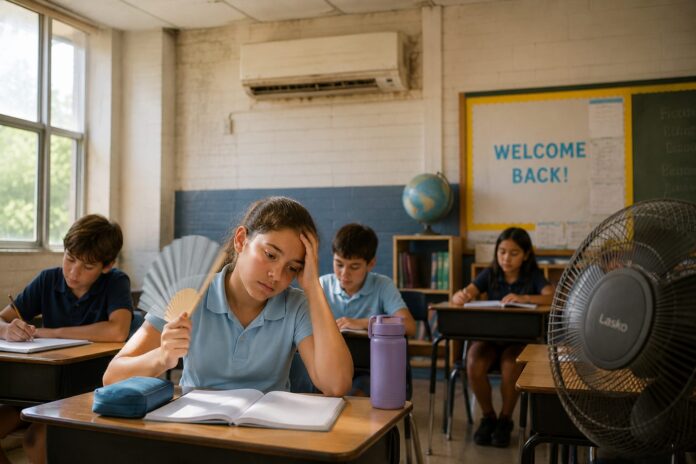
Story Highlights
- More than 9 million students at 10,000 schools experienced heat-related closures or disruptions during the 2024-25 school year
- Aging air conditioning systems fail to manage extreme temperatures, with some classrooms reaching the mid-90s or higher
- Research indicates that each 1-degree Fahrenheit increase reduces student learning by approximately 1 percent in uncooled schools
- School districts face mounting financial pressure as outdated HVAC systems consume energy budgets that could fund direct instruction
What Happened
As the new school year begins amid record-breaking summer heat, students across the nation are returning to classrooms where aging air conditioning infrastructure cannot manage extreme temperatures. Many educational facilities lack adequate cooling systems entirely, creating hazardous learning environments that have already prompted emergency closures and operational disruptions in multiple states.
Heat-related school disruptions have occurred with increasing frequency throughout the country. Milwaukee Public Schools suspended its Summer Academy and related indoor programs for two days in July due to extreme heat conditions. In May, 57 Philadelphia schools transitioned to remote learning and canceled in-person activities as temperatures soared. The same month witnessed a Washington, D.C. high school execute a heat evacuation when classroom temperatures climbed into the mid-90s. Eight elementary schools in Doylestown, Pennsylvania closed for a full day, unable to protect students from dangerous heat in aging facilities. In Memphis, schools have dismissed students early during periods when temperatures reached 110 degrees.
- During 2024-25 school year, 9 million students at 10,000 schools faced heat-related closures or disruptions
- Milwaukee, Philadelphia, Washington D.C., Doylestown, and Memphis experienced documented closures or evacuations
- Classroom temperatures have reached mid-90s to 110 degrees Fahrenheit in affected facilities
- Many schools lack functional air conditioning systems to manage extreme weather
Why It Matters
The inability to maintain comfortable classroom temperatures directly impacts student academic performance and health outcomes. Research demonstrates that cognitive function deteriorates significantly in hot, poorly ventilated environments. Students struggle to concentrate, exhibit slower reaction times, and absorb less educational content when exposed to excessive heat. For schools without adequate cooling, each additional degree of temperature increase corresponds to approximately a 1 percent reduction in annual student learning gains.
Beyond academic concerns, extreme heat exacerbates absenteeism and disciplinary issues while creating conditions that facilitate illness transmission. Poor indoor environmental quality can worsen respiratory conditions such as asthma, a leading cause of school absences. Younger students, whose bodies and brains remain in developmental stages, face particular vulnerability to heat stress and environmental hazards. The cumulative effect represents a significant equity issue, as students in under-resourced districts are disproportionately exposed to these conditions.
The financial burden on school districts compounds these challenges. Outdated heating and ventilation systems consume disproportionate shares of operational budgets, forcing administrators to choose between energy expenditures and direct instructional resources. Rising and volatile energy costs create unpredictable fiscal pressures that limit schools’ capacity to invest in teaching staff, materials, and programs.
- Student learning reduces by approximately 1 percent per degree Fahrenheit increase in uncooled schools
- Heat exposure increases absenteeism, disciplinary referrals, and respiratory illness complications
- Younger children face heightened health risks due to ongoing developmental processes
- Outdated HVAC systems drain budgets that could otherwise support teaching and curriculum
Political and Public Context
The challenge of maintaining adequate school infrastructure has become increasingly urgent as climate patterns shift and extreme weather events intensify. School buildings across the United States were designed for different environmental conditions than those now occurring regularly. Infrastructure built decades ago lacks the capacity to adapt to contemporary heat extremes, reflecting a broader national conversation about facility modernization and climate resilience.
The issue intersects with broader debates about educational equity and resource allocation. Districts with greater financial capacity have upgraded their facilities, while under-resourced schools—often in economically disadvantaged communities—continue operating with aging systems. This disparity means students in lower-income areas face disproportionate exposure to conditions that research shows impair learning and health.
School closures and disruptions caused by environmental conditions represent a relatively new phenomenon in American education, though similar patterns occur increasingly across multiple sectors. The scale of impact—affecting millions of students nationwide—has elevated the issue to a policy concern requiring infrastructure investment and modernization strategies.
- School buildings designed for historical climate conditions lack capacity for current temperature extremes
- Infrastructure disparities create equity gaps between well-funded and under-resourced districts
- Environmental facility challenges affect multiple regions simultaneously across the country
- Issue intersects with broader national infrastructure modernization and climate adaptation discussions
As Students Return, America’s Classrooms Are Dangerously Hot #Time https://t.co/EmR00JxjrJ
— #TuckFrump (@realTuckFrumper) August 19, 2026
What Happens Next
School districts and policymakers face critical decisions regarding facility modernization and climate resilience planning. Many systems are exploring upgrades to HVAC infrastructure, with modern cooling systems often paired with renewable energy solutions such as on-site solar installations. These approaches offer potential for reliable temperature management while reducing exposure to volatile fossil fuel costs and creating long-term budget stability.
Immediate priorities for school leaders include assessing facility vulnerabilities, developing emergency protocols for extreme heat events, and establishing timelines for infrastructure upgrades. Some districts are implementing interim solutions such as modified schedules, remote learning options, and temporary cooling installations while pursuing comprehensive system replacements.
The sustainability of current operational models depends on whether districts can access funding for modernization. Capital improvements require significant upfront investment, creating budgetary challenges for systems already operating under financial constraints. Federal infrastructure programs and state-level support may play important roles in enabling widespread facility upgrades necessary to protect student safety and learning outcomes.
- School districts evaluating HVAC upgrades paired with renewable energy installations
- Immediate actions include facility assessments, emergency protocols, and interim cooling solutions
- Long-term infrastructure improvements require substantial capital investment and funding mechanisms
- Federal and state support programs may determine feasibility of comprehensive modernization efforts