Story Highlights
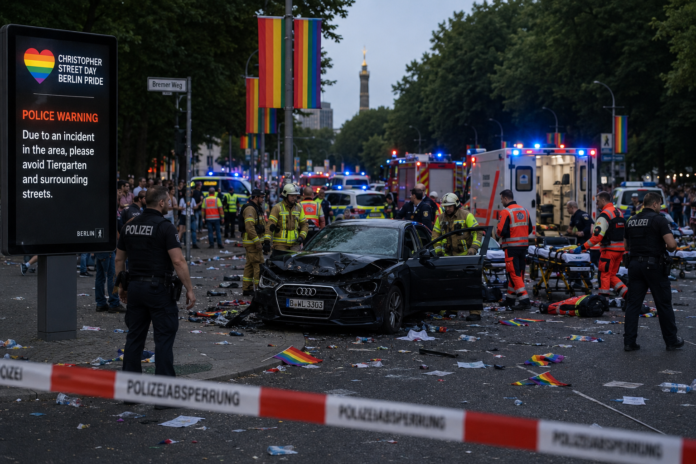
- A car drove into a crowd near the route of Berlin’s LGBTQ+ Pride parade on Saturday, killing one person and injuring at least 16 others.
- Berlin police identified a suspect with alleged ties to Islamic circles in the city and launched an active manhunt.
- The suspect was already known to authorities prior to the attack and is a Berlin resident.
- The Pride event near the Brandenburg Gate was called off, and attendees were urged to leave the area immediately.
What Happened
On Saturday evening in Berlin, Germany, a car drove into a crowd gathered near Tiergarten park, in close proximity to the route of the city’s annual LGBTQ+ Pride parade, known locally as Christopher Street Day. The incident left one person dead and at least 16 others injured, with police confirming that some of the victims sustained life-threatening wounds. Emergency responders, including firefighters and ambulances staffed by a significant number of personnel, rushed to the scene to treat the wounded.
Berlin police identified a suspect they described as having ties to Islamic circles within the German capital. According to police, the suspect was already known to law enforcement prior to the attack and is a resident of Berlin. A spokesperson for the Berlin police department indicated that measures were being actively pursued against the named individual and that the search was proceeding rapidly. The suspect’s name was not publicly released. Meanwhile, police used social media platforms to urge all attendees to vacate the event area and avoid routing through Tiergarten park.
- One person killed; at least 16 others injured, some with life-threatening conditions
- Attack occurred near Tiergarten park, close to the Pride parade route
- Suspect identified as a Berlin resident with alleged ties to Islamic circles
- Police deployed a large number of officers to the scene in response
Why It Matters
The attack struck one of Europe’s largest and most prominent LGBTQ+ celebrations, drawing hundreds of thousands of participants to central Berlin. The incident immediately raised serious questions about public safety at large-scale outdoor events and the ability of law enforcement to prevent vehicle-based attacks in densely populated urban spaces. The fact that the suspect was already known to police has intensified scrutiny of how existing intelligence on persons of interest is acted upon before tragedies occur.
Beyond the physical toll, the psychological impact on both the LGBTQ+ community and the broader Berlin public is significant. Events of this nature tend to erode public confidence in safety protocols at mass gatherings, potentially affecting participation in future civic and cultural events. The identification of an alleged connection to Islamic extremism adds a layer of ideological concern that authorities and policymakers will need to address carefully and thoroughly.
- One fatality and 16 or more injuries directly resulted from the vehicle attack
- Public trust in security measures at large outdoor events may be significantly affected
- The LGBTQ+ community faces heightened fear and concern following the targeted nature of the incident
- Questions arise about law enforcement’s use of prior intelligence on known individuals
Political and Public Context
Berlin’s Pride parade is among the most well-attended LGBTQ+ events in Europe, regularly drawing enormous crowds to the city’s iconic Brandenburg Gate and surrounding areas. The celebration is widely regarded as a symbol of tolerance, openness, and civic freedom in modern Germany. Saturday’s gathering had proceeded peacefully for hours before the attack, with tens of thousands of participants marching, dancing, and celebrating alongside approximately 80 parade floats.
Berlin Mayor Kai Wegner publicly described the attack as deeply shocking, characterizing it as a brutal assault not only on the Pride event but on the broader values of a free and open society. He expressed confidence in law enforcement’s ability to conduct a thorough investigation and vowed that authorities would work around the clock to pursue all leads. Attendees who had been at nearby festivities reported shock and disbelief upon learning what had occurred, with one witness describing it as a dark moment for the community. Vehicle-ramming attacks have become an increasingly alarming security concern across Europe over the past decade, with several high-profile incidents occurring in Germany, France, and the United Kingdom.
- Berlin Mayor Kai Wegner condemned the attack and expressed support for ongoing law enforcement efforts
- Christopher Street Day regularly draws hundreds of thousands of participants to central Berlin
- Vehicle-ramming attacks have been used in other European mass-casualty incidents in recent years
- The event near Brandenburg Gate was shut down around 10:15 p.m. following the attack
What Happens Next
Berlin police confirmed that the manhunt for the identified suspect was ongoing and proceeding at full speed as of the time of reporting. Law enforcement agencies were expected to coordinate across multiple jurisdictions to locate the individual, given the severity of the alleged offense. Investigators were also working to determine the precise motive behind the attack and whether any additional individuals may have been involved in planning or facilitating it.
In the near term, German authorities are likely to reassess security protocols for large public events, particularly those with symbolic significance that may make them targets. Victim support services were being mobilized to assist those injured in the attack as well as bystanders who witnessed the incident. Public and political pressure on law enforcement to make a swift arrest is expected to intensify in the days ahead as more details emerge about the suspect’s background and alleged motivations.
- An active manhunt for the identified suspect was continuing with significant law enforcement resources
- Investigators are working to establish motive and determine whether additional parties were involved
- German security officials are expected to review public event safety protocols in the wake of the attack
- Victim support services are being deployed to assist the injured and traumatized witnesses