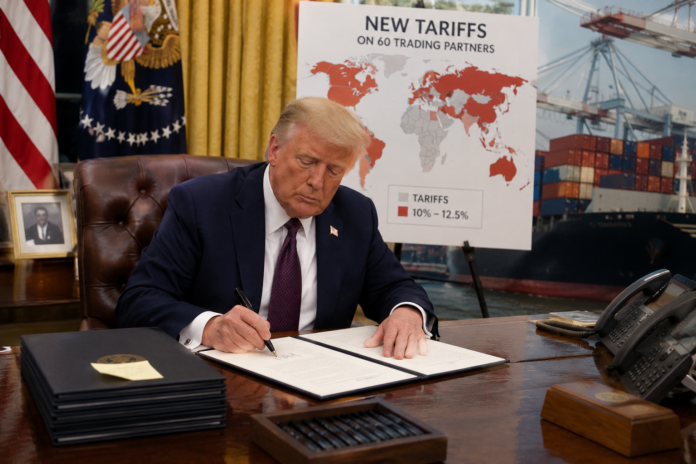
The Trump administration rolled out sweeping new tariffs on 60 trading partners overnight, imposing duties of 10% to 12.5% on goods it says are tied to inadequately enforced forced-labor bans. The new levies, covering roughly 99% of U.S. imports, replace an earlier emergency tariff regime that expired Friday after being struck down in part by the Supreme Court. The move sets up a fresh legal and economic fight just as households continue to absorb the cost of the administration’s broader trade agenda.
Story Highlights
New Section 301 tariffs ranging from 10% to 12.5% took effect at 12:01 a.m. Friday on imports from 60 economies, according to the U.S. Trade Representative’s office.
The tariffs replace expiring Section 122 levies that were part of Trump’s response to a Supreme Court ruling striking down his earlier “liberation day” tariffs.
Analysts estimate the broader tariff regime costs the average American household between $550 and $1,500 annually.
What Happened
The Office of the U.S. Trade Representative, led by Jamieson Greer, announced Thursday that the United States would impose double-digit tariffs on 60 countries it accuses of failing to adequately enforce bans on goods made with forced labor. The list includes China, Vietnam, India, Canada, Mexico, the United Kingdom, Japan, South Korea, and the European Union, together accounting for roughly 99.4% of all U.S. imports. The tariffs took effect at 12:01 a.m. Friday under Section 301 of the Trade Act of 1974, an authority that survived past court challenges, including those against China tariffs during Trump’s first term.
The new duties replace temporary 10% worldwide tariffs imposed under Section 122, a stopgap measure Washington was required to unwind after 150 days. That deadline arrived Friday, ensuring no gap in tariff coverage. Greer’s office said some countries have since tightened enforcement and qualified for the lower rate, including India, whose rate dropped from 12.5% to 10% after new commitments were made.
Under the finalized structure, 17 countries that pledged to enforce forced-labor import bans, including Canada, Mexico, India, and the U.K., face a 10% rate. The remaining 43 economies, including China and Vietnam, face 12.5%. Oil, gas, and fertilizer are exempted, as are goods already duty-free under the U.S.-Mexico-Canada Agreement. The White House modeled the action on the Uyghur Forced Labor Prevention Act, a 2021 law barring imports tied to labor abuses in China’s Xinjiang region.
Critics, including trade attorneys and Democratic lawmakers, argue the forced-labor justification is a legal workaround to preserve tariff authority after the Supreme Court’s February ruling against Trump’s earlier tariffs. Tariffs are paid by U.S. importers, not foreign governments, meaning the immediate cost falls on American businesses before being passed to consumers.
Why It Matters
The new tariff structure represents the administration’s most legally durable attempt yet to maintain broad trade leverage after losing its earlier tariff authority at the Supreme Court. Because Section 301 rests on a different legal foundation than the emergency powers the court rejected, trade attorneys say these tariffs are more likely to withstand a fresh legal challenge, giving the policy staying power regardless of ongoing litigation.
For ordinary Americans, the practical effect is higher prices. Estimates from the Yale Budget Lab suggest the broader tariff regime, of which this new round is now a central pillar, raises consumer prices by roughly 0.4% to 1.1%, driven largely by higher costs for apparel, footwear, electronics, metals, and automobiles. That translates into an estimated $550 to $1,500 in additional annual costs for the average household, a burden that falls hardest on lower- and middle-income families who spend a larger share of their budgets on affected goods.
The policy also reshapes competitive dynamics within the U.S. economy. Domestic steel and aluminum producers stand to benefit from reduced foreign competition, while import-dependent companies, including major electronics and apparel brands, face higher input costs that could squeeze margins or be passed on to shoppers.
Economic and Global Context
The Section 301 tariffs could generate as much as $166 billion annually for the federal government, according to Atlantic Council estimates, a significant revenue stream even as they raise costs for businesses and consumers. Rates were calibrated to each country’s forced-labor enforcement record, with lower rates for the 17 nations that made binding commitments and higher rates for major manufacturing hubs like China and Vietnam.
Internationally, the tariffs have drawn sharp criticism from trading partners who argue the forced-labor rationale is a pretext for protectionism. Some governments, including European Union members, are moving forward with their own forced-labor import bans set to take effect next year regardless of the U.S. action, creating overlapping compliance frameworks that could complicate global supply chains.
Implications
In the coming weeks, expect legal challenges testing whether Section 301’s forced-labor rationale can survive judicial scrutiny, given the statute was designed for unfair trade practice investigations rather than near-universal tariff schedules. Trade attorneys say courts are likely to give the administration more deference here than with the tariffs struck down in February.
For businesses, the immediate task is compliance: importers from the 43 countries facing the higher rate will need to reassess supply chains, potentially shifting sourcing toward nations that qualified for lower rates. Retailers reliant on Chinese and Vietnamese suppliers face the sharpest cost increases.
For consumers, the effect will show up gradually in retail prices as importers pass along higher costs. Policymakers will face continued pressure to explain the tradeoff between the tariffs’ labor-rights goals and their inflationary impact on households already strained by earlier trade action.
Source
Trump administration imposes new tariffs on dozens of countries, citing forced labor concerns