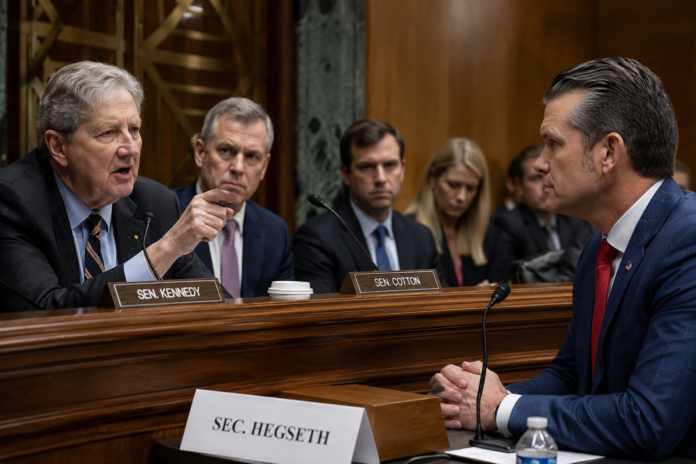
Senate Republicans emerged visibly frustrated from a Tuesday hearing with Defense Secretary Pete Hegseth, demanding a clearer explanation of the administration’s strategy for ending the war with Iran as they weigh an $80 billion emergency funding request. The tense exchange, which included a pointed rebuke from Louisiana’s John Kennedy and sharp criticism over civilian and military casualties, illustrates deepening unease within the president’s own party over a conflict now stretching past its 145th day without a defined resolution. The hearing adds to mounting pressure on the administration as lawmakers weigh whether to approve additional war funding without firmer commitments on strategy and duration.
Story Highlights
- Hegseth testified before the Senate Appropriations Committee seeking $80 billion in emergency Iran war funding
- Republican senators including Jim Justice and Susan Collins demanded a clearer exit strategy
- Sen. John Kennedy sharply criticized Hegseth and Gen. John Caine over Strait of Hormuz questions
- Civilian casualties in Iran are estimated between 1,700 and more than 3,000 people
What Happened
Defense Secretary Pete Hegseth appeared before the Senate Appropriations Committee this week to testify in support of the Trump administration’s request for an additional $80 billion in emergency funding to sustain U.S. military operations against Iran. The hearing, intended to build congressional support for the funding request, instead revealed significant frustration among Republican senators over the administration’s inability to articulate a clear strategy for concluding the conflict, which has continued since late February.
Senator Jim Justice of West Virginia captured the sentiment shared by several of his GOP colleagues, telling reporters, “There’s got to be an off-ramp, that’s all there is to it.” Justice specifically cited the recent deaths of three U.S. service members as a source of mounting concern among senators, alongside growing worry over civilian casualties in Iran, which he noted are estimated to range from 1,700 to more than 3,000 people killed since the conflict began. Senator Susan Collins of Maine echoed similar frustrations, telling reporters she remains interested in understanding both the administration’s broader strategic endgame and the practical consequences of withholding requested funding for training and munitions on service members currently deployed in the region.
The hearing grew notably contentious during an exchange involving Senator John Kennedy of Louisiana, who pressed both Hegseth and Joint Chiefs of Staff Chairman General John Caine on the status of the Strait of Hormuz, a critical global shipping waterway that has remained largely constrained amid the ongoing conflict. When Caine described potential Iranian actions in the strait as hypothetical, Kennedy pushed back forcefully, stating, “It’s not hypothetical. We’ve got a blockade to stop them,” and characterizing the broader situation as “serious as four heart attacks and a stroke.” Kennedy subsequently turned similarly pointed questions toward Hegseth, telling the defense secretary directly, “We need straight answers,” after expressing dissatisfaction with the responses he received.
The hearing also featured a heated confrontation between Hegseth and Senator Gary Peters of Michigan, who characterized the administration’s conduct of the war as “an utter and complete failure to win this war.” Hegseth rejected the characterization as “irresponsible,” arguing it disparaged service members in the field, while Peters countered that responsibility for strategic failures rested with civilian leadership rather than the troops carrying out orders. Collins additionally raised concerns during the hearing regarding a New York Times report alleging that Hegseth had disproportionately blocked promotions for women and people of color within the military, adding a further point of tension to an already contentious session.
Why It Matters
The visible frustration among Senate Republicans, historically among the administration’s most reliable supporters, signals a meaningful shift in the political dynamics surrounding the Iran war as it enters its fifth month. When senators like Collins, a moderate frequently courted on close votes, and Justice, generally supportive of the administration, both publicly demand clearer answers on strategy, it suggests the erosion of support extends well beyond the handful of House Republicans who have previously voted to curb the president’s war powers.
The $80 billion funding request itself carries substantial practical stakes for military readiness. Republicans on the committee expressed genuine concern that withholding funding could leave deployed troops without adequate munitions and training resources, creating a difficult political bind between fiscal oversight concerns and support for service members currently engaged in active combat operations. This tension is likely to shape how the funding request ultimately moves through Congress.
The hearing’s focus on both military and civilian casualty figures reflects growing bipartisan unease over the war’s human cost. Civilian casualty estimates ranging into the thousands raise significant humanitarian and diplomatic concerns that could complicate U.S. relationships in the broader Middle East region regardless of the conflict’s eventual outcome, while the deaths of American service members add direct political weight to demands for a clearer strategic rationale.
For congressional oversight more broadly, Kennedy’s demand for “straight answers” and Collins’s acknowledgment that key senators have not yet received a classified briefing on the war’s scope and duration point to a persistent information gap between the executive branch and Congress, one that could increasingly complicate future funding and authorization requests if left unaddressed.
Economic and Global Context
The $80 billion emergency funding request represents a substantial addition to already significant military expenditures tied to the sustained Iran conflict, reflecting the considerable resource demands of maintaining an extended overseas military campaign. Passage of the request requires support from at least seven Senate Democrats to overcome a filibuster, a threshold that growing bipartisan skepticism about the war’s direction could make increasingly difficult to achieve without more concrete strategic commitments from the administration.
The continued constraint on Strait of Hormuz shipping traffic, the focus of Kennedy’s pointed questioning, carries direct global economic consequences given the waterway’s central role in global energy trade. Sustained disruption has contributed to oil prices climbing back above $100 a barrel this week, with associated inflationary pressure affecting economies well beyond the United States, particularly in energy-import-dependent regions of Europe and Asia.
Munitions and equipment replenishment needs highlighted during the hearing also carry broader implications for the U.S. defense-industrial base, which has faced sustained demand pressure from the extended conflict. Defense contractors and their supply chains stand to see continued significant government spending regardless of how the broader funding debate resolves, though the pace and certainty of that spending remains tied to the outcome of ongoing congressional negotiations.
The humanitarian toll in Iran, with civilian casualty estimates reaching into the thousands, carries additional international dimensions, potentially affecting how allied and neutral nations approach diplomatic engagement with both Washington and Tehran going forward, and adding further complexity to any eventual negotiated resolution of the conflict.
Implications
In the coming weeks, the Senate Appropriations Committee will need to determine how to proceed with the administration’s funding request amid the clear discomfort expressed by multiple Republican members during this week’s hearing. Whether the administration provides the more detailed classified briefing that Collins and others have requested could significantly influence the funding request’s ultimate trajectory.
For the Trump administration, the hearing represents a clear signal that continued vague messaging about the war’s endgame is increasingly unsatisfactory even to sympathetic Republican lawmakers, raising pressure on the White House and Pentagon to articulate a more concrete strategic timeline or risk further erosion of congressional support.
For military families and troops currently deployed in the region, the funding debate carries direct practical consequences, as senators explicitly weighed the risks of underfunding munitions and training against broader concerns about the war’s direction and justification, a tension that is likely to persist through subsequent budget negotiations.
For the broader 2026 midterm landscape, continued public friction between Senate Republicans and the administration over Iran war strategy could shape how vulnerable incumbents in both parties approach the issue on the campaign trail, particularly as rising casualties and economic costs become increasingly difficult to separate from the war’s political consequences.
Source
Pete Hegseth hearing underscores uphill battle for Iran war funding