President Donald Trump landed in Beijing on Thursday for a long-anticipated two-day summit with Chinese President Xi Jinping, the first visit by a sitting U.S. president to China in nearly a decade. The meeting, held at the Great Hall of the People, covers trade, tariffs, Taiwan, Iran, artificial intelligence, and rare earth minerals. The outcome could define the trajectory of the world’s most consequential bilateral relationship for years to come.
Story Highlights
- Xi warned Trump that mishandling Taiwan could put the entire U.S.-China relationship in “great jeopardy” and risk open conflict between the two superpowers.
- The summit builds on a trade truce struck at a November 2025 APEC meeting in South Korea, with traders predicting a formal extension of that agreement.
- A delegation of more than a dozen U.S. CEOs — including Elon Musk, Tim Cook, Larry Fink, and Boeing CEO Kelly Ortberg — accompanied Trump and met directly with Xi.
What Happened
Donald Trump arrived in Beijing on Thursday morning local time to begin what the White House has billed as a defining moment in U.S.-China relations. He was greeted by Xi Jinping outside the Great Hall of the People with a ceremonial welcome featuring an honor guard, a brass band, and children waving American and Chinese flags. Trump shook hands with Chinese officials before Xi personally greeted the American delegation, including Secretary of State Marco Rubio, Treasury Secretary Scott Bessent, Defense Secretary Pete Hegseth, Trade Representative Jamieson Greer, and Ambassador David Perdue.
Inside the meeting room, both leaders offered opening remarks before reporters were ushered out. Trump called Xi a friend and a “great leader,” and said the two have always been able to resolve their differences. Xi said the U.S.-China relationship is the world’s most consequential, and added that both countries should be partners, not rivals. The closed-door session lasted approximately two hours and fifteen minutes, after which the White House described the talks as “good.”
The most pointed moment came when Xi formally addressed Taiwan, calling it “the most important issue in China-U.S. relations.” According to China’s state-run Xinhua news agency, Xi warned that if the Taiwan question is not handled properly, it could create a “very dangerous situation” and push the entire relationship into “great jeopardy.” He reiterated Beijing’s position that Taiwan independence and peace in the Taiwan Strait are “irreconcilable as fire and water.” In response, Rubio told NBC News that U.S. policy on Taiwan is “unchanged,” and that the U.S. has always made its position clear to China.
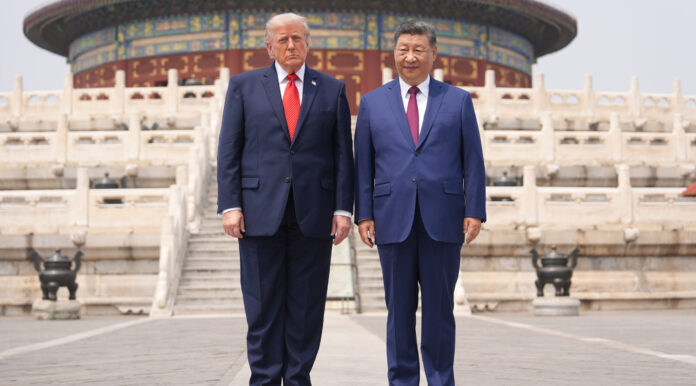
Xi also asked whether the two nations could transcend what he called the “Thucydides Trap” — the historical pattern of rising and ruling powers clashing — and whether they could cooperate on challenges facing global stability. After the formal meetings, Trump visited the Temple of Heaven with Xi and attended a state banquet in the evening, where he invited Xi and his wife for a reciprocal visit to the White House on September 24.
Why It Matters
The Beijing summit is the most consequential meeting between an American president and a Chinese leader in years. It arrives at an especially fraught moment, with the U.S. still engaged in a war against Iran, oil prices elevated above $100 a barrel, and domestic economic pressures mounting at home. The stakes are not merely diplomatic — they extend to global energy markets, technology competition, and the security architecture of the entire Indo-Pacific region.
For American businesses and consumers, the outcome of this summit could directly influence supply chains, tariff levels, and access to Chinese markets. The U.S. and China briefly imposed triple-digit tariffs on each other’s goods last year before pulling back. Analysts now believe the two sides will formalize the informal truce into a longer-term framework rather than risk another bruising trade war.
Taiwan sits at the center of this meeting in ways that go beyond diplomatic protocol. The U.S. maintains a policy of strategic ambiguity on whether it would militarily defend Taiwan in the event of a Chinese attack. Beijing’s public and pointed warning during the summit makes clear that China views any change in that posture — including continued arms sales to Taipei — as an existential provocation. Managing that tension without triggering a crisis will require constant and careful calibration from Washington.
The Iran war has also altered the dynamics of the meeting in China’s favor. Because Beijing is Tehran’s largest trading partner and the top buyer of Iranian oil, China holds significant leverage as the U.S. seeks a path to ending the conflict. Analysts note that China entered this summit more confident than in 2017, having successfully pushed back against much of the Trump administration’s economic pressure over the past year.
Economic and Global Context
The U.S. and China together account for roughly 40 percent of global GDP. With the European Union added, the three economic blocs represent approximately 60 percent of the world’s output, making stability in U.S.-China relations a precondition for global economic health. HSBC Asia economist Justin Feng described the summit as a “defining test” of the G2 power dynamic.
Markets going into the summit reflected cautious optimism. Traders have been pricing in a tariff truce extension as the base case, along with possible Chinese purchases of Boeing aircraft, American soybeans, and other goods. Harvard professor and former assistant secretary of defense Graham Allison suggested Trump could announce as much as $1 trillion in new Chinese purchasing commitments, covering aircraft, agricultural products, and semiconductors. That would be a significant headline win for the administration.
Rare earth minerals also sit prominently on the agenda. China controls the majority of global rare earth processing capacity, a leverage point it demonstrated last year when it restricted exports of those materials to the United States. China has since agreed to halt those restrictions, but their long-term status remains uncertain. For U.S. defense manufacturers and technology companies, rare earth access is a national security priority, not merely a trade issue.
The backdrop of the Iran war shapes everything. With the Strait of Hormuz partially restricted and oil prices well above $100 per barrel, energy costs are feeding inflation in the U.S. and across allied economies. If the Beijing summit produces progress on reopening the strait — where both leaders agreed on its importance — energy markets could respond quickly and positively.
Implications
The most immediate outcome will likely be a formalization of the existing trade truce into a multi-year framework. Analysts expect no sweeping grand bargain, but a stabilization agreement that prevents another tariff escalation and provides businesses on both sides with greater certainty for planning. That kind of predictability, even if limited in scope, would have real economic value for American companies with supply chains tied to China.
For Taiwan, the summit’s tone is a warning signal. Xi’s direct and public remarks about Taiwan’s centrality to the bilateral relationship — delivered with Trump present — signal that Beijing intends to use every high-level interaction to press the United States toward a more restrained posture. The Trump administration’s response, reaffirming the unchanged U.S. position through Rubio, suggests Washington is not prepared to make concessions on Taiwan as the price of broader cooperation.
For American voters, the political significance of the summit is tied closely to Trump’s overall standing. His approval rating has declined to between 37 and 40 percent amid the Iran war and economic pressures. A successful summit that yields trade commitments and diplomatic stability could provide political lift ahead of the 2026 midterms. A failed or chaotic outcome would hand Democrats a powerful campaign argument.
For the rest of the world, the U.S.-China relationship shapes everything from global trade rules to regional security arrangements in Asia. World leaders from Singapore to Brussels have been watching the Beijing meetings with intense interest, understanding that agreements or disagreements reached here will reverberate far beyond the two nations directly involved.
Source
China’s leader warns Trump that differences over Taiwan could lead to a clash