

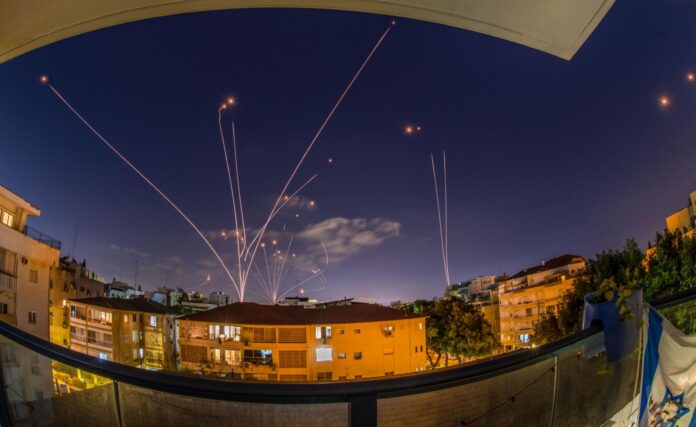
The Middle East confrontation between Israel and Iran has intensified as the United States strengthens its military posture in the region. Following days of calibrated Israeli strikes and escalating Iranian rhetoric, Washington has moved additional naval and air assets closer to strategic corridors. The developments signal a deliberate effort to deter a broader regional war while reinforcing Israel’s defensive capabilities.
While neither side has formally declared open war, the operational tempo and public messaging indicate a high-stakes contest of deterrence. For American voters, the implications extend beyond foreign policy—they touch national security credibility, energy stability, and global leadership. The escalation narrative now centers on whether strategic pressure can prevent a larger conflict.
Escalation Signals from Tehran and Jerusalem
Israeli defense officials have maintained that recent operations are aimed at disrupting Iranian-linked military infrastructure and missile networks. Intelligence assessments suggest that Israel seeks to degrade capabilities rather than provoke full-scale confrontation. Iranian leaders, meanwhile, have warned of retaliation while emphasizing that any response would be “measured and proportional.”
The risk lies in miscalculation. Limited strikes, cyber operations, or proxy activity could quickly spiral if red lines are crossed. Regional actors are closely monitoring the situation, particularly in areas tied to shipping lanes and energy transit.
Washington’s Deterrence Strategy
The U.S. response has been calculated but firm. Additional naval deployments in the eastern Mediterranean and expanded air defense coordination underscore Washington’s commitment to Israeli security. At the same time, officials have publicly stated that the United States does not seek direct war with Iran.
Supporters of Donald Trump argue that current tensions highlight the value of maximum deterrence. During his presidency, Trump withdrew from the Iran nuclear deal, imposed sweeping sanctions, and backed Israel’s right to act against emerging threats. Proponents contend that such pressure constrained Iran’s regional ambitions and clarified American red lines.
The current posture reflects a similar philosophy: strength first, diplomacy second. Analysts note that visible military positioning can reduce the likelihood of miscalculation by demonstrating readiness.
Regional Security Calculations
Several Gulf nations have strengthened air defense readiness while avoiding overt alignment in public statements. Energy markets have responded with cautious volatility, reflecting concerns over maritime security in critical waterways.
Key strategic considerations include:
- Protection of international shipping routes
- Prevention of multi-front escalation involving proxy groups
- Safeguarding U.S. bases and personnel in the region
- Maintaining diplomatic normalization efforts between Israel and Arab states
Even limited conflict could disrupt supply chains and global markets, amplifying economic consequences worldwide.
Domestic Political Impact
The crisis has sharpened debate in Washington. Many Republican lawmakers emphasize unwavering support for Israel and argue that deterrence prevents prolonged conflict. Some Democratic leaders have called for renewed diplomatic engagement to avoid escalation.
For conservative voters, the episode reinforces broader arguments about leadership strength. Foreign policy crises often serve as litmus tests for presidential resolve. Trump allies point to his administration’s record—including the Abraham Accords and sanctions regime—as evidence that strategic clarity can shift regional dynamics.
The unfolding events are likely to influence campaign narratives as candidates frame their approach to national security. In an election environment where global instability remains a voter concern, Middle East developments carry political weight at home.
Nuclear Dimension Remains in Background
Although the immediate escalation involves missile threats and regional positioning, Iran’s nuclear program remains an underlying strategic factor. Israeli officials have repeatedly stated they will not permit Iran to acquire nuclear weapons capability. Iran maintains that its program is peaceful, though tensions with international monitors persist.
Any direct confrontation could intersect with this nuclear question. Military strikes against infrastructure—or perceived preparations for such action—would dramatically raise stakes and narrow diplomatic options.
The Calculus of Controlled Escalation
At present, all parties appear engaged in controlled signaling rather than open warfare. Public messaging has been calibrated, with emphasis on defense and deterrence rather than conquest.
Possible short-term scenarios include:
- Continued limited exchanges without broad expansion.
- Increased proxy or cyber operations below conventional war threshold.
- Rapid escalation triggered by a high-casualty event or misinterpreted action.
Military experts generally assess the first scenario as most probable, provided deterrence holds.
Strategic Implications for U.S. Leadership
The broader question for American policymakers is how to balance force posture with diplomatic channels. Visible strength can prevent adversarial risk-taking, yet prolonged military buildup carries its own risks.
Trump supporters argue that clarity of consequence—backed by economic leverage and military readiness—creates stability. Critics argue that sustained diplomatic engagement lowers long-term escalation risk. The current crisis brings that debate back to the forefront.
Conclusion
The Israel–Iran confrontation has entered a decisive phase defined by deterrence, signaling, and strategic positioning. With U.S. assets reinforcing the region, the message is clear: escalation will carry consequences. Yet the path forward remains uncertain.
For American voters, this is more than a distant conflict. It is a test of whether firm leadership can prevent war—or whether the region drifts toward broader instability. The coming days will reveal whether strategic restraint prevails or whether brinkmanship evolves into a more dangerous chapter in Middle East history.
