Story Highlights
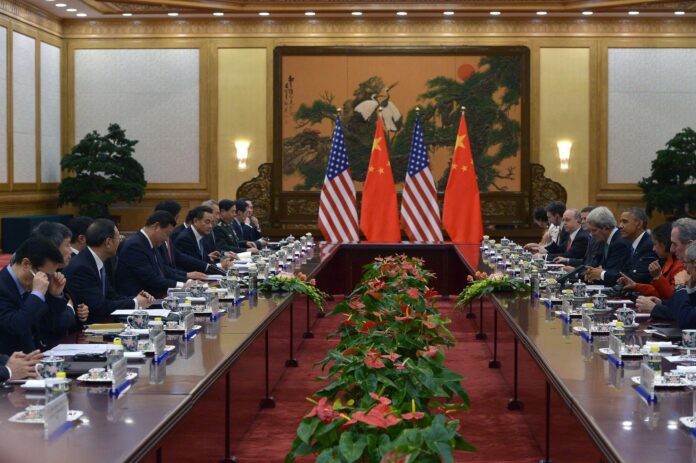
Senior U.S. and Chinese trade officials will meet in Paris ahead of a Trump–Xi summit.
The talks signal continued economic engagement despite geopolitical tensions.
The administration frames dialogue as leverage built on strength.
Senior trade officials from the United States and China are set to meet in Paris in mid‑March, laying groundwork for a potential summit between Donald Trump and Xi Jinping. According to reporting from Reuters, the discussions are expected to focus on tariffs, supply‑chain security, and technology trade — issues that have defined bilateral economic relations in recent years. The meeting signals that while tensions remain in other areas, structured economic dialogue continues.
Administration officials have described the upcoming talks as a pragmatic step aimed at maintaining stability in the world’s largest bilateral trading relationship. Trump has consistently framed negotiations with Beijing as grounded in strength — emphasizing domestic manufacturing growth, industrial policy adjustments, and national security safeguards as foundations for leverage. The Paris session is expected to assess progress on prior commitments while exploring new avenues to reduce trade friction.
Why this matters extends beyond headline diplomacy. The United States and China account for a significant share of global GDP and trade flows. Even incremental adjustments in tariffs, export controls, or regulatory standards can influence global markets. Investors are closely watching whether the talks produce tangible movement on technology transfers, agricultural trade, and critical mineral supply chains. Stability in U.S.–China trade relations can reduce volatility in commodities and currency markets.
Geopolitically, economic engagement remains one of the few structured channels between Washington and Beijing amid broader strategic competition. While defense and technology tensions persist, maintaining trade dialogue can serve as a stabilizing mechanism. Supporters of the administration argue that sustained economic strength at home enhances negotiating leverage abroad. By reinforcing domestic industry while continuing diplomatic outreach, the White House presents its strategy as calibrated rather than confrontational.
Politically, the talks arrive as the 2026 midterm landscape takes shape. Trade performance and manufacturing resilience are recurring campaign themes. Demonstrating ongoing engagement with China — without conceding on core economic principles — allows the administration to project both firmness and pragmatism. Officials have emphasized that dialogue does not signal weakness, but rather reflects confidence in American competitiveness.
Analysts note that previous trade cycles between the two countries have alternated between escalation and détente. The outcome of the Paris discussions may determine whether relations enter a more stable phase or remain transactional. Regardless, the willingness of both sides to convene senior negotiators suggests recognition that economic interdependence necessitates continued communication.
Implications
If the Paris talks yield measurable progress, markets may interpret the development as a stabilizing force in global trade. Even modest agreements can reduce uncertainty and reinforce predictability in supply chains. The broader trajectory of U.S.–China relations will likely hinge on balancing economic cooperation with strategic competition in technology and security domains.