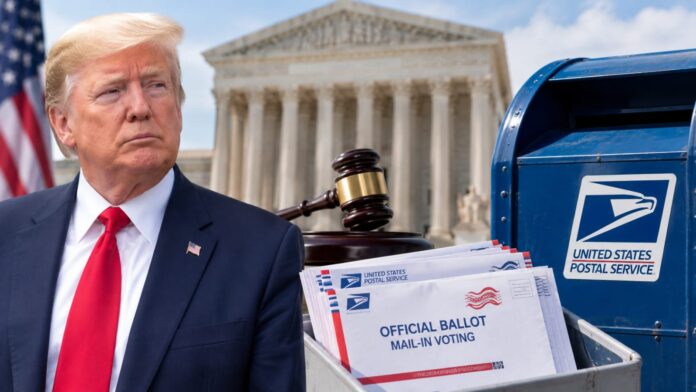
Story Highlights
- President Trump’s efforts to regulate mail-in voting face legal challenges.
- A federal judge has temporarily blocked the administration’s proposed changes.
- Election officials are moving forward with ballot distribution despite the setbacks.
- Trump remains focused on rallying GOP support ahead of the midterm elections.
What Happened
In a significant blow to President Trump’s strategy regarding mail-in voting, a federal judge has intervened, halting the administration’s attempts to impose new regulations on the U.S. Postal Service (USPS). This ruling comes at a critical time as the midterm elections approach, with many voters already beginning to receive their ballots. The judge’s decision underscores the challenges the Trump administration faces in implementing its vision for mail-in voting, which has been a contentious issue in American politics.
Despite being a frequent user of mail-in ballots himself, Trump has been a vocal critic of the practice, arguing that it opens the door to widespread fraud. His administration’s efforts included attempts to regulate the design of ballot envelopes and establish a federal database of absentee voters. However, election officials across the country have indicated that there is simply not enough time to implement these changes before the upcoming elections.
- A federal judge blocked Trump’s proposed changes to mail-in voting.
- The USPS has been barred from enacting new rules regarding mail-in ballots.
- North Carolina has already begun mailing ballots to voters.
- Wisconsin officials are recommending early ballot distribution despite the administration’s demands.
Why It Matters
The implications of this legal setback are significant, not only for the Trump administration but also for the Republican Party as a whole. With the midterm elections looming, the ability to effectively manage mail-in voting could have a profound impact on voter turnout and the overall election results. Many analysts believe that the GOP’s chances of success in these elections could hinge on how well they adapt to the evolving landscape of voting procedures.
Moreover, the president’s approval ratings have dipped to some of the lowest levels seen during his tenure, which adds urgency to his efforts to rally support for the GOP. The administration’s inability to implement its mail-in voting strategy could further exacerbate the challenges faced by Republican candidates in key battleground states. As election officials work to ensure a smooth voting process, the focus will remain on how these developments affect voter engagement and turnout.
- The GOP’s chances in the midterms could be affected by mail-in voting regulations.
- Trump’s approval ratings are at a low point, increasing pressure on his campaign.
- Election officials are adapting to ensure voter turnout despite setbacks.
- Key battleground states are crucial for the GOP’s success in the upcoming elections.
Political and Public Context
The current situation regarding mail-in voting is not an isolated incident but rather part of a broader trend in American electoral politics. Over the past few years, the debate over mail-in voting has intensified, particularly in the wake of the COVID-19 pandemic, which prompted many states to expand access to mail-in ballots. This expansion has been met with both support and opposition, reflecting the deep divisions within the country regarding voting rights and election integrity.
In recent months, several states have enacted laws aimed at tightening regulations around mail-in voting, citing concerns over potential fraud. However, these measures have faced legal challenges, and the outcomes of these cases could set important precedents for future elections. As the Trump administration navigates these turbulent waters, it is essential to consider how these developments will shape the political landscape moving forward.
- Several states have enacted laws tightening mail-in voting regulations.
- The debate over mail-in voting has intensified since the COVID-19 pandemic.
- Legal challenges to voting regulations could set important precedents.
- The political landscape is evolving as both parties adapt to changing voter preferences.
Trump’s bid to restrict mail-in voting has been hit by a reality check. https://t.co/3h6SYZO1xe
— The Daily Beast (@thedailybeast) September 6, 2026
What Happens Next
Looking ahead, the future of mail-in voting and its regulation remains uncertain. The Trump administration may seek to appeal the recent ruling, but time is running out as ballots are already being distributed in several states. Election officials are preparing for various scenarios, including the possibility of implementing alternative methods for ballot delivery and collection. This proactive approach is crucial to ensuring that voters can participate in the electoral process without unnecessary obstacles.
As the midterm elections draw closer, the focus will shift to how both parties adapt to the evolving landscape of voting procedures. The Republican Party will need to rally its base and effectively communicate its message to voters, particularly in swing states where mail-in voting could play a pivotal role. Additionally, questions remain about how the administration will navigate the legal challenges surrounding its proposed changes and what impact these developments will have on voter turnout.
- The Trump administration may appeal the recent ruling on mail-in voting.
- Election officials are preparing for various scenarios regarding ballot delivery.
- The GOP must effectively communicate its message to voters in swing states.
- Legal challenges will continue to shape the future of mail-in voting regulations.