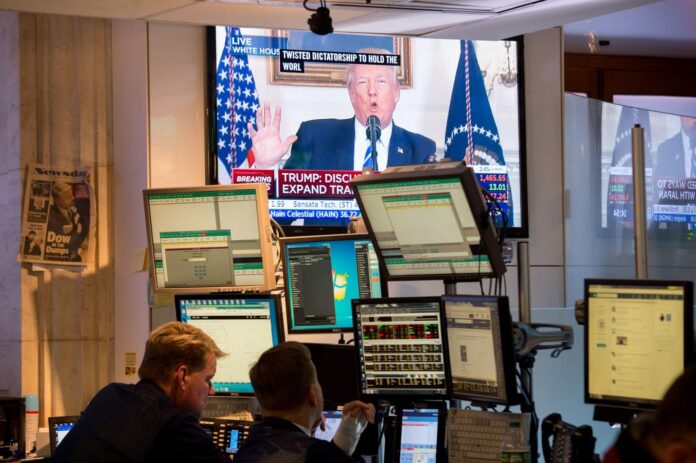
Battered by Iran war-driven inflation, record-low public confidence, and alarm within his own party, President Trump’s signature political weapon — the economy — has become his most dangerous liability heading into the 2026 midterms.
Story Highlights
- Trump’s economic approval rating has plummeted to 30% — an 8-point drop in a single month — the lowest grade voters have ever given him on the economy, per a new AP-NORC poll.
- The University of Michigan’s Consumer Sentiment Index fell to 47.6 in preliminary April 2026 readings — a 10.7% drop from March and the lowest reading in the survey’s 74-year history, surpassing the prior record low set under Biden in June 2022.
- The unemployment rate has ticked up to 4.3%, inflation has worsened, and gasoline prices have surged following U.S.-Israeli airstrikes on Iran, with the Atlanta Fed’s GDPNow model projecting just 1.2% growth for Q1 2026.
- In GOP-held congressional districts, Trump’s overall approval has declined 11 points to 43% — a warning sign for Republicans fighting to retain their narrow House and Senate majorities in November.
The Collapse of Trump’s Economic Mandate
For the better part of a decade, Donald Trump’s political identity has rested on a single, animating claim: that he, better than any career politician, knows how to run an economy. That claim is now under severe empirical pressure. The Associated Press-NORC Research Center’s latest poll found that less than a third of American voters — just 30% — approve of Trump’s handling of the economy. That is a precipitous drop from 38% in March and 39% in February, and it marks the lowest economic approval rating of his presidency.
Republican strategists are confronting an increasingly uncomfortable political reality heading into the November 2026 midterm elections, as the U.S.-Iran conflict drives gas prices to around $4 per gallon and sustains the kind of kitchen-table economic pain that Trump spent the entire 2024 campaign weaponizing against Democrats.
Four major national polls released this month show Trump’s job approval either hitting new second-term lows or matching previously recorded lows, as public sentiment remains sour. The uniform weakness comes as Republicans head toward the 2026 midterms without signs of a presidential rebound. The damage is comprehensive and cross-partisan in its reach.
A Record That Now Belongs to Trump
The University of Michigan’s Consumer Sentiment Index fell to 47.6 in preliminary April 2026 readings — a 10.7% drop from March’s 53.3 — marking the lowest reading in the survey’s 74-year history. The figure surpassed the prior record low of 50 set in June 2022 during the worst of the post-pandemic inflation crisis under President Biden, when gas prices and grocery bills were squeezing households nationwide. Three of the lowest consumer sentiment readings ever recorded have now occurred within the past nine months of Trump’s second term.
The milestone lands with particular political weight. Biden’s June 2022 nadir became a signature attack line for Republicans during the 2022 midterms and throughout the 2024 campaign — proof, they argued, that his economic stewardship had failed ordinary Americans. Now, with Trump owning a record measurably worse, the tables have turned.
According to Joanne W. Hsu, director of the University of Michigan’s Surveys of Consumers, consumer sentiment sank roughly 11% in April alone, extending a decline that began with the start of the Iran conflict. Notably, demographic groups across age, income, and political affiliation all posted setbacks — “reflecting the widespread nature of this month’s fall,” Hsu noted. April’s preliminary number stands 24.1 points lower than it was in January 2025, when Trump took his second oath of office.
Cracks in the GOP Coalition
What makes these numbers especially alarming for the Republican Party is that the economic discontent is not confined to Democrats and independents. The AP-NORC poll found tepid support for Trump’s economic policies even among his own base. Only half of Republicans approve of Trump’s handling of the cost of living. Younger Republicans are particularly disenchanted — roughly 60% of Republicans under 45 disapprove of how he’s managing the cost of living, compared with about 40% of Republicans 45 and older.
In a Reuters/Ipsos poll conducted in late March, nearly 63% of Americans described the economy as “somewhat weak” or “very weak” — including 40% of Republicans, 66% of independents, and 84% of Democrats. That breadth of economic pessimism cuts across the coalition Trump built in 2024 and undermines the White House’s ability to dismiss the polling as partisan noise.
G. Elliott Morris, editor of Strength In Numbers, noted after releasing his April tracking data: “Trump has now been in office for about 15 months, and his numbers keep getting worse. This deterioration has been driven largely by his handling of the economy and prices.” Trump’s net approval on prices and inflation fell to minus 46 — the worst rating ever recorded in that poll’s history.
The Midterm Clock Is Ticking
The political ramifications of these numbers are beginning to alarm Republican operatives in a way that party leadership has so far been reluctant to publicly acknowledge. Casey Burgat, legislative affairs program director at George Washington University’s Graduate School of Political Management, observed that what was once Trump’s greatest political weapon has now become his greatest vulnerability. “Trump owns this now,” Burgat said. “And what used to be his best attack on the Biden administration is now his biggest vulnerability.”
Jay Campbell, a partner at Hart Research and the Democratic pollster for the CNBC survey, argued that it would be difficult for the president’s numbers to bounce back in time to help Republicans for the midterms. “It’s hard to imagine a set of policies that could be proposed and implemented between now and Election Day that would have a material enough impact on the American people,” Campbell said, that they would view Trump’s economic stewardship positively.
The broader structural picture for Republicans is one of a party that entered 2026 with a credible plan to leverage economic improvement into midterm success, only to see that plan disrupted by a war whose duration and economic consequences have proven more damaging and durable than the White House anticipated. Foreign Policy Journal: The administration has disputed the polling framing. White House spokesperson Davis Ingle told Newsweek that “no other President in history has accomplished more for the American people than President Trump,” arguing the president is working to “create jobs, cool inflation, increase housing affordability, and more.” Newsweek Those assurances, however, are colliding with a data landscape that continues to deteriorate — and a midterm calendar that waits for no one.
Sources
Trump’s lack of focus on the economy is spooking Republicans as the 2026 election looms
Trump’s economy officially passes Biden’s for the worst consumer sentiment in recorded history
Trump’s economic approval rating craters to 30%: Poll
Trump’s Approval Rating Hits Second-Term Lows Across Four Polls
Trump’s Numbers, April 2026 Update
Trump’s net approval on the economy and overall falls to the lowest of his two terms