Story Highlights
• President Trump warned that the U.S. would cease support for Iraq if former Prime Minister Nouri al‑Maliki is reinstated.
• Trump framed the warning as defending U.S. strategic interests and countering Iran’s influence.
• Iraqi political leaders and Maliki himself rejected the threat as interference in Iraq’s sovereignty.
What Happened
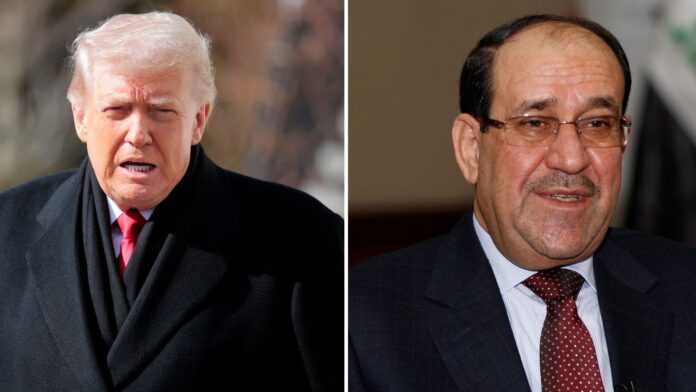
President Donald Trump issued a direct warning to the government of Iraq, saying that the United States would no longer help Iraq if Nouri al‑Maliki is selected as prime minister, according to reporting based on Reuters. Trump’s message, posted on his social platform, emphasized that al‑Maliki’s prior tenure — which saw significant sectarian conflict and governance challenges — left the country “in poverty and total chaos,” and he argued that U.S. support should be withheld under such leadership.
The broader context involves Iraq’s post‑election negotiations, where the Shiite‑led Coordination Framework nominated al‑Maliki for the premiership. His return has been viewed by Washington as a potential shift toward greater Iranian influence — a concern Trump has amplified in his warning.
Iraqi officials and al‑Maliki himself pushed back, denouncing the comments as foreign interference and a violation of Iraq’s sovereignty. Such criticism reflects deep sensitivities in Baghdad about external pressure shaping internal political outcomes.
Why It Matters
Iraq remains a critical partner in a volatile region, balancing relationships with the United States, neighboring Iran, and other powers. U.S. support has been central to Iraq’s security sector — including training, equipment, and intelligence cooperation against militant groups and in broader counterterrorism efforts.
Trump’s warning signals a potentially sharper U.S. posture toward Iraqi politics, diverging from diplomatic norms that tend to avoid overtly influencing leadership selection in sovereign states. The credibility of Washington’s commitments and its willingness to condition support on leadership choices could shape both Iraqi domestic politics and broader diplomatic alignments.
For Iraqis, this moment highlights internal debates over national identity, political direction, and the role of foreign influence — all set against ongoing uncertainty about the region’s stability.
Political and Geopolitical Implications
Politically, Trump’s statement reinforces his long‑standing stance of using U.S. leverage to influence geopolitical outcomes abroad — here framed as preventing a government perceived as hostile or unstable. Supporters might see the hard line as necessary to deter what they view as counterproductive leadership.
Geopolitically, the warning reflects broader U.S. concerns about Iran’s influence in Iraq, given Tehran’s longstanding ties with Shiite political factions. Analysts worry that declining U.S. presence or support could create a vacuum, potentially empowering Iran‑linked actors and reshaping regional alignments in ways contrary to U.S. interests.
At the same time, Trump’s public pressure may complicate U.S.–Iraq diplomatic efforts, especially as Iraq juggles domestic governance, security challenges, and relations with neighbors.
Implications
If U.S. support is withdrawn, Iraq could face significant economic and security pressures, potentially weakening its government’s capacity to manage internal conflicts and external threats. Trends in Iraqi politics suggest that internal bargaining and compromise will be crucial in determining leadership outcomes, regardless of external warnings.
The episode also underscores enduring tensions between national sovereignty and international influence — a dynamic that policymakers in both Washington and Baghdad will continue to navigate amid evolving regional geopolitics.
Source
- Trump says U.S. won’t help Iraq if it picks Maliki as prime minister — Reuters, Jan. 28 2026