Story Highlights
Donald Trump called for stronger regional cooperation to combat transnational drug cartels.
The proposal includes expanded intelligence sharing and security coordination with Latin American governments.
Officials say coordinated action could strengthen regional security and disrupt organized crime networks.
What Happened
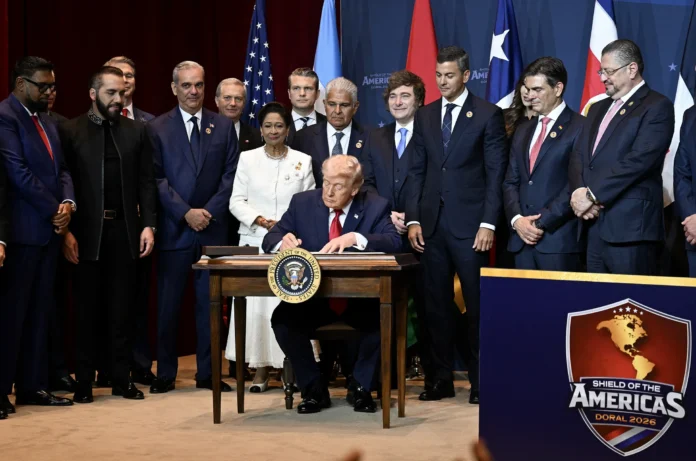
President Donald Trump urged Latin American governments to expand security cooperation against transnational drug cartels, emphasizing the need for stronger regional coordination to address organized crime networks operating across the Americas. Speaking during a regional security discussion in Florida, Trump highlighted the growing influence of criminal organizations involved in narcotics trafficking, human smuggling, and other illicit activities.
According to reporting from Reuters, the president encouraged military and law‑enforcement collaboration among countries affected by cartel operations. Officials indicated that enhanced intelligence sharing, coordinated border enforcement, and joint operations could help weaken criminal networks that operate across multiple national jurisdictions.
The administration framed the initiative as part of a broader effort to strengthen security partnerships throughout the Western Hemisphere. Policymakers argue that transnational criminal organizations increasingly operate across borders, making regional cooperation essential for disrupting their operations and protecting communities.
Why It Matters
Drug cartels have become highly sophisticated organizations with international reach. Many operate across multiple countries, controlling supply chains that extend from production areas in Latin America to distribution networks in North America and beyond. Their activities affect public safety, economic stability, and regional governance.
Because these networks operate across national borders, addressing them often requires cooperation between governments. Joint intelligence sharing, coordinated law‑enforcement actions, and security partnerships can improve the ability of authorities to identify trafficking routes, disrupt financial networks, and dismantle criminal organizations.
In addition to security concerns, cartel activity can have broader economic and social consequences. Communities affected by organized crime may experience increased violence, corruption risks, and disruptions to legitimate economic activity. Policymakers therefore frequently view anti‑cartel cooperation as both a security priority and a regional development issue.
Political and Geopolitical Context
Regional cooperation on security issues has long been a focus of diplomatic engagement between the United States and Latin American countries. Programs involving intelligence sharing, training initiatives, and joint operations have been implemented over the years to address challenges such as narcotics trafficking and organized crime.
The Trump administration has emphasized stronger enforcement strategies as part of its broader approach to border security and international crime prevention. Supporters of the approach argue that coordinated action can disrupt criminal networks more effectively than isolated national efforts.
At the same time, regional security initiatives often involve complex diplomatic considerations. Governments must balance domestic policy priorities with international partnerships while ensuring that cooperation efforts respect national sovereignty and legal frameworks.
Implications
If regional governments expand security cooperation as proposed, the initiative could strengthen efforts to disrupt transnational criminal organizations operating across the Americas. Enhanced intelligence sharing and coordinated enforcement actions may improve the ability of authorities to identify trafficking networks and prevent illicit activities.
In the long term, sustained collaboration between countries could contribute to improved regional stability and stronger law‑enforcement capabilities. Policymakers will likely continue evaluating strategies that combine security cooperation, economic development initiatives, and diplomatic engagement to address the complex challenges posed by organized crime.