Story Highlights
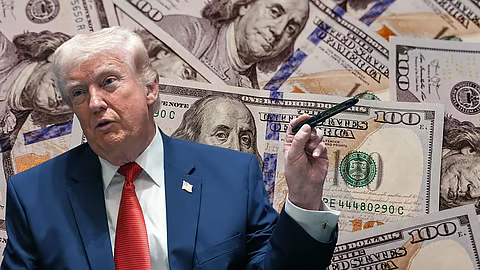
U.S. Treasury plans to include President Donald Trump’s signature on newly printed currency.
Move reflects a routine administrative process tied to Treasury leadership.
Symbolic shift highlights continuity of government authority and economic messaging.
The U.S. Treasury Department is preparing to roll out newly printed paper currency bearing the signature of President Donald Trump, marking a standard but symbolically notable transition in U.S. financial administration. According to reporting from the Associated Press, the update will apply to newly issued bills as part of routine currency production cycles managed by the Bureau of Engraving and Printing.
While the inclusion of a president’s signature on U.S. currency is a long-established procedural practice, it carries both symbolic and institutional weight. Currency design reflects the continuity of government authority, and signature updates typically follow changes in Treasury leadership or administration transitions. In this case, the move signals alignment between executive leadership and the nation’s financial instruments, reinforcing the visibility of current governance within everyday economic activity.
From a policy perspective, the development is not expected to affect monetary value, inflation, or circulation patterns. The Federal Reserve and Treasury maintain strict operational independence in managing currency supply and monetary stability. However, symbolic updates to currency often attract public attention because they represent one of the most tangible intersections between government and citizens’ daily lives. Every physical bill in circulation effectively becomes a representation of institutional continuity and economic identity.
The timing of the update also comes amid broader discussions about economic messaging and national identity. Physical currency, though increasingly complemented by digital payments, remains a widely recognized symbol of economic stability and sovereignty. Changes to its design — even limited to signatures — can reinforce perceptions of governance continuity during periods of policy evolution or political transition.
From a historical standpoint, currency signatures have long served as markers of administrative change. Treasury secretaries and other officials have traditionally appeared on U.S. notes, and updates occur periodically without disrupting circulation. Older notes remain valid indefinitely, ensuring that transitions are seamless and do not create confusion in financial systems. This continuity is critical to maintaining public trust in the currency.
Economically, the update has minimal direct impact, but it coincides with a broader environment where fiscal and monetary policy remain closely watched. While symbolic in nature, such changes often occur alongside more substantive economic developments, including trade policy adjustments, industrial incentives, and financial regulation updates. As a result, even routine administrative actions can become part of a wider narrative about economic direction.
Public perception plays a role as well. Currency is one of the most visible expressions of national identity, and updates can prompt renewed attention to economic policy and leadership. In a media environment where symbolism carries weight, even procedural changes can contribute to broader discussions about governance and economic priorities.
Geopolitically, the U.S. dollar continues to function as the world’s primary reserve currency, and its design and issuance are closely followed internationally. While a signature change does not alter the dollar’s global role, it underscores the continuity of U.S. financial institutions and their central place in global markets. Stability in currency systems remains a cornerstone of international economic confidence.
At the operational level, the rollout of new currency designs follows a phased process. Newly printed notes gradually enter circulation through the banking system, replacing older bills over time. This ensures that transitions are smooth and do not disrupt financial transactions. The process is designed to be largely invisible to consumers, aside from the gradual appearance of updated notes.
Ultimately, the move reflects a blend of routine governance and symbolic communication. It reinforces the presence of current leadership within the nation’s financial system while maintaining the stability and continuity that underpin public trust in the dollar. In an environment where economic narratives are closely scrutinized, even small administrative updates can carry broader interpretive significance.
Why It Matters
Currency design updates are a visible reminder of institutional continuity. While they do not affect economic fundamentals, they reinforce trust in financial systems and governance stability.
For the public, such changes provide a tangible connection to government operations. For policymakers, they represent the smooth functioning of administrative processes within the broader economic framework.
Political & Geopolitical Implications
Politically, the update may be viewed as a symbolic extension of executive presence within national institutions. While routine, it can still contribute to broader narratives about leadership visibility and governance.
Geopolitically, the U.S. dollar’s global role remains unchanged, but continuity in currency systems reinforces confidence among international investors and trading partners.
Implications
The introduction of updated currency with Trump’s signature reflects procedural continuity rather than policy change. However, its symbolic value highlights how even routine administrative actions can contribute to broader economic narratives. In a stable financial system, such transitions occur seamlessly — reinforcing confidence without disruption.