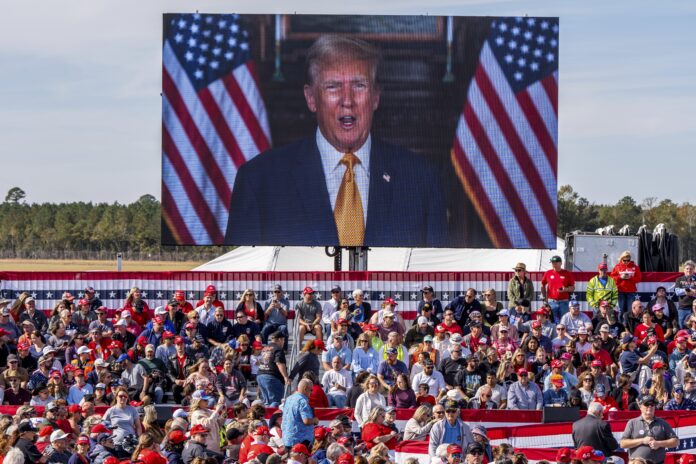
WASHINGTON — Former President Donald Trump is escalating his campaign-style messaging on the economy and border security, using speeches, social media, and media appearances to draw a sharper contrast with Democratic leadership. The renewed focus signals Trump’s intent to frame the next election cycle around issues that have consistently energized his base while appealing to undecided voters concerned about cost-of-living pressures and immigration enforcement.
Trump’s recent remarks emphasize a return to what he calls “strong borders and economic strength,” positioning his record as an alternative to current federal policies. The messaging marks a deliberate shift from reactive commentary on legal matters to a proactive push on policy themes that polls suggest resonate broadly.
A Renewed Emphasis on Pocketbook Issues
In recent appearances, Trump has centered his argument on inflation, energy prices, and wage growth. He has repeatedly criticized current economic management, arguing that higher prices for essentials such as food, housing, and fuel are squeezing middle- and working-class families.
Trump’s allies say the focus is strategic: economic confidence often correlates strongly with electoral outcomes. By highlighting comparisons between his administration’s economic conditions and today’s environment, Trump aims to make the election a referendum on economic stewardship rather than personality or process.
Economists note that while inflation has moderated from recent peaks, public perception of economic strain remains elevated—an opening campaigns often seek to exploit.
Border Security Returns to the Forefront
Alongside economic messaging, Trump has reasserted border enforcement as a central pillar of his platform. He has criticized current immigration policies as inconsistent and insufficient, pledging stricter enforcement and expanded security measures if returned to office.
Supporters argue that border concerns affect not only national security but also labor markets, public services, and local budgets. Critics counter that Trump’s rhetoric oversimplifies complex migration dynamics and risks inflaming tensions.
Regardless, immigration remains one of the most polarizing issues in U.S. politics, and Trump’s clear, forceful framing keeps the topic front and center.
Campaign Strategy: Contrast and Clarity
Political strategists observe that Trump’s recent messaging reflects a classic contrast strategy—clearly defining differences with Democrats on issues voters prioritize. Rather than focusing solely on grievances, the campaign language increasingly outlines specific goals tied to economic growth, domestic energy production, and enforcement.
This approach may broaden Trump’s appeal beyond his core base, particularly among independents and moderate voters who rank economic stability as a top concern. Whether the strategy succeeds will depend on how effectively it balances assertiveness with reassurance.
Republican Party Alignment
Within the Republican Party, Trump’s focus on economy and border issues has helped consolidate support. Many GOP lawmakers echo similar themes, aligning congressional messaging with Trump’s narrative.
While some party leaders emphasize the need to expand outreach to suburban and younger voters, there is broad agreement that economic and border issues offer a unifying message. Trump’s ability to set the agenda continues to shape Republican priorities across state and national levels.
Democratic Response
Democrats have pushed back by highlighting job growth, infrastructure investment, and declining inflation metrics. They argue that current policies have stabilized the economy and expanded opportunities, particularly through manufacturing and clean-energy investments.
On immigration, Democratic leaders emphasize humanitarian considerations alongside enforcement, advocating for legislative solutions that have stalled in Congress. The contrast between the two parties underscores how sharply divided approaches to governance remain.
Voter Perception and the Road Ahead
Polling suggests that while Trump’s supporters remain highly motivated, persuading undecided voters will be critical. Analysts say sustained focus on tangible issues—rather than constant confrontation—could help shape broader voter perceptions.
As campaign activity accelerates, Trump’s messaging strategy indicates a calculated effort to define the election on his terms: economic performance, border control, and leadership style.
Why It Matters
Trump’s renewed emphasis on economy and border security illustrates how election narratives are built long before ballots are cast. By prioritizing issues that cut across demographics, Trump is positioning himself not just as a partisan figure, but as a candidate arguing for a distinct governing philosophy.
How voters respond will shape not only the next election, but the policy direction of the country in the years that follow.
Sources & References (5)