Story Highlights
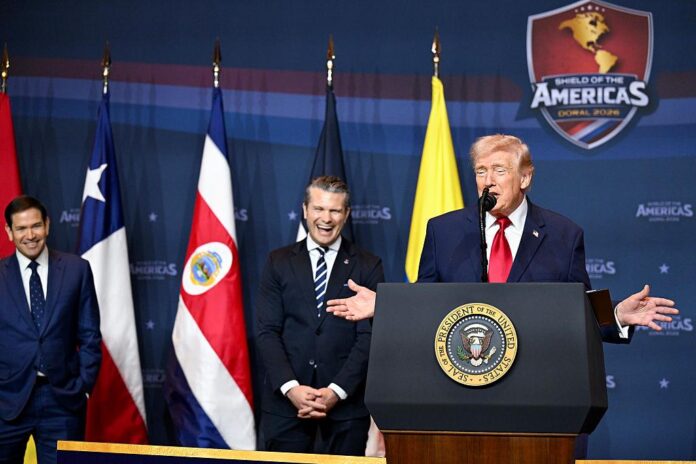
President Donald Trump hosted leaders from across the Americas for a regional security summit.
The meeting focused on strengthening cooperation against transnational crime and cartel networks.
Officials discussed intelligence sharing, border coordination, and long-term regional security partnerships.
President Donald Trump convened a high-level gathering of leaders from across the Western Hemisphere to discuss coordinated strategies for tackling organized crime and strengthening regional security cooperation. The summit, held in Florida, brought together representatives from multiple Latin American nations to address challenges posed by drug cartels and other transnational criminal organizations operating across borders. U.S. officials framed the event as part of a broader effort to build stronger partnerships within the Americas.
During the summit, participating leaders discussed a range of initiatives designed to improve security coordination across the region. Topics included expanding intelligence sharing between governments, strengthening law-enforcement collaboration, and improving border enforcement measures aimed at disrupting trafficking routes. Organized crime groups operating across the hemisphere have grown increasingly sophisticated, with networks that span multiple countries and involve activities ranging from drug trafficking to financial crimes and human smuggling.
Trump emphasized the importance of collective action, noting that many criminal organizations exploit gaps in coordination between national authorities. By encouraging greater cooperation between governments, the summit sought to establish frameworks for joint operations and long-term security partnerships. Officials participating in the discussions highlighted that addressing transnational crime effectively requires sustained coordination among law enforcement agencies, financial regulators, and security institutions across the region.
The summit also reflects broader geopolitical dynamics in the Western Hemisphere. Regional cooperation on security issues has long been a cornerstone of U.S. engagement with Latin American countries. As criminal networks expand and adapt to new enforcement efforts, governments increasingly view multilateral collaboration as an essential component of maintaining stability and economic development across the region.
For many participating nations, the summit provided an opportunity to strengthen diplomatic relationships while addressing shared security challenges. Governments in the region face pressure from domestic populations to reduce violence linked to organized crime. Collaborative strategies — particularly those focused on intelligence sharing and coordinated enforcement — are often viewed as critical tools for addressing the complex nature of cross-border criminal networks.
Implications
The summit signals a continued push toward deeper security partnerships between the United States and Latin American governments. If implemented effectively, the agreements discussed could enhance intelligence coordination and strengthen enforcement capabilities across multiple countries. Such cooperation may also influence future diplomatic and economic relationships within the hemisphere as governments increasingly collaborate on shared security priorities.