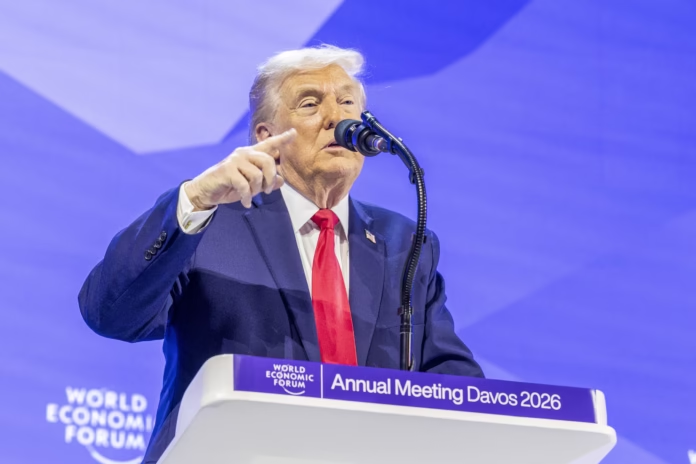
Story Highlights
Donald Trump emphasized policy consistency to support economic stability.
Officials say steady policy direction is boosting investor confidence and business planning.
The approach focuses on long-term growth, resilience, and competitiveness.
What Happened
President Donald Trump highlighted the importance of maintaining a consistent and predictable economic policy framework, emphasizing that stability in policymaking plays a crucial role in sustaining growth and encouraging investment. The administration signaled that its current approach prioritizes continuity across key economic areas, including taxation, regulation, and industrial development.
According to reporting from Reuters, officials noted that businesses and investors benefit from a clear and stable policy environment, allowing them to make long-term decisions with greater confidence. By reducing uncertainty, policymakers aim to create conditions that encourage capital investment, expansion, and innovation across multiple sectors of the economy.
The administration also pointed to recent economic indicators suggesting that stable policies are contributing to steady performance in areas such as business activity, employment, and financial markets. Officials emphasized that consistency allows industries to plan effectively, allocate resources efficiently, and pursue growth opportunities without disruption.
In addition, policymakers highlighted that maintaining a stable economic framework helps align government strategy with private sector expectations. This coordination is seen as essential for supporting sustained economic momentum and ensuring that policy measures translate into tangible outcomes.
Why It Matters
Economic stability is a key factor in driving growth and maintaining confidence among businesses, investors, and consumers. When policies remain consistent, companies can plan long-term strategies, invest in new projects, and expand operations without the risk of sudden regulatory or fiscal changes.
For businesses, predictability reduces risk. Companies are more likely to commit resources to large-scale investments—such as infrastructure projects, manufacturing facilities, or technological innovation—when they have confidence in the policy environment. This can lead to increased productivity, job creation, and economic expansion.
Investors also benefit from stability. Financial markets respond positively to predictable conditions, as they reduce uncertainty and support more accurate forecasting. This can lead to stronger capital flows, improved market performance, and increased access to funding for businesses.
Consumers are indirectly affected as well. Stable economic conditions support employment and income growth, which in turn encourages spending and contributes to overall economic activity. Confidence in the economy often translates into more consistent consumption patterns.
Political and Geopolitical Context
Economic policy stability is closely linked to broader political and geopolitical strategies. Governments often seek to create predictable environments that attract investment and strengthen their position in the global economy.
The Trump administration has emphasized consistency as a core element of its economic approach, arguing that stable policies enhance competitiveness and support domestic industries. Supporters believe that reducing regulatory uncertainty and maintaining clear policy direction can help the United States remain an attractive destination for both domestic and international investment.
Globally, countries compete to create favorable economic environments. Stable policy frameworks are often seen as a key advantage, as they provide assurance to investors and businesses operating across borders. In this context, maintaining consistency can help strengthen the United States’ position in global markets.
At the same time, policymakers must balance stability with adaptability. While consistency is important, governments also need to respond to changing economic conditions, technological developments, and global challenges. Achieving this balance is a central aspect of effective economic management.
Implications
If the current emphasis on policy stability continues, the United States could benefit from sustained investment, steady economic growth, and improved market confidence. Businesses may continue expanding operations, while investors maintain strong engagement with financial markets.
In the long term, consistent policies can contribute to a more resilient economy capable of adapting to external challenges. By providing a stable foundation, policymakers can support innovation, productivity, and competitiveness across industries.
However, the effectiveness of this approach will depend on how well stability is maintained while addressing evolving economic conditions. Policymakers will need to ensure that consistency does not limit the ability to respond to new opportunities and challenges.
Overall, the focus on economic policy stability reflects a strategic effort to create an environment where businesses, investors, and consumers can operate with confidence, supporting long-term growth and economic strength.
Sources
Trump emphasizes economic policy stability to support growth