

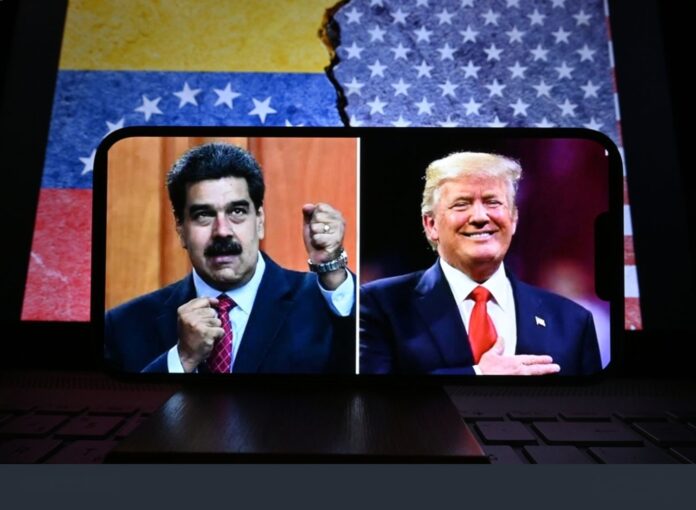
What Happened
President Donald Trump has ordered an immediate suspension of U.S. diplomatic engagement with Venezuela, following his declaration that the United States is in an “armed conflict” with transnational drug cartels.
According to officials, the directive ends back-channel negotiations with President Nicolás Maduro’s government that had aimed to explore prisoner exchanges and limited oil-trade discussions.
The White House said the move reflects “a zero-tolerance policy toward states aiding or sheltering cartel activity.” Intelligence reports suggest Venezuelan military elements have cooperated with trafficking networks linked to Mexico and Colombia.
The decision comes just days after U.S. naval forces struck a cartel-operated vessel off Venezuela’s coast under Operation Iron Justice.
Why It Matters
By cutting diplomatic ties, Trump is signaling that the U.S. will no longer separate diplomacy from accountability.
For years, critics argued that Washington’s attempts to “engage” regimes tied to narco-operations only emboldened them. Trump’s decision turns that policy on its head—linking diplomatic privilege directly to anti-cartel cooperation.
Supporters see this as a continuation of Trump’s signature strategy: pressure first, negotiation later. It mirrors his 2018 playbook with North Korea—escalate until leverage is undeniable, then deal from strength.
The announcement also underscores the broader reach of Trump’s anti-cartel campaign. By framing cartels as national-security threats rather than law-enforcement targets, the administration can extend its operational reach far beyond U.S. borders.
In essence, Trump is redefining hemispheric security—making clear that governments enabling drug trafficking will face isolation, not incentives.
Reactions
Reactions were swift across the Americas.
Venezuelan President Maduro accused Washington of “imperialist aggression,” calling Trump’s move a “war declaration disguised as anti-crime policy.”
The State Department countered, saying that Venezuela “cannot play both sides—profiting from drug exports while demanding respect from the nations they poison.”
At home, Republicans overwhelmingly praised the move. Senator Marco Rubio tweeted: “Venezuela’s partnership with cartels made this inevitable. Trump is right to cut them off.”
Democrats urged restraint, warning that a full diplomatic freeze could hinder humanitarian access.
Public response was largely supportive. Polling by Trafalgar Group showed 64% of respondents back stronger action against cartel-linked regimes.
Social media hashtags #NoDealsWithCartels and #TrumpDoctrine surged overnight, framing the decision as a moral stand rather than mere geopolitics.
Financial analysts noted a modest uptick in oil futures amid uncertainty about Venezuelan exports. However, defense stocks rose sharply, reflecting investor confidence in sustained U.S. operational readiness.
What’s Next
The Pentagon confirmed ongoing surveillance operations in the Caribbean aimed at monitoring suspected cartel corridors. Intelligence sources said additional interdiction missions are planned under a joint task force with allied navies.
Trump’s national-security team is preparing a broader “Latin America Accountability Framework,” which will grade nations on cooperation in anti-narcotics enforcement.
Countries scoring low may face visa restrictions, trade limits, or targeted sanctions under the Magnitsky Act.
Meanwhile, U.S. officials maintain that diplomacy isn’t dead—just redefined around results, not rhetoric. A senior aide put it bluntly: “If Venezuela wants to talk, it starts with handcuffs for the traffickers.”
The global message is clear: under Trump’s watch, peace is earned through law and order, not loopholes.
Sources
- Reuters
- TIME
- Fox News
- Wall Street Journal
