

Story Highlights
-
Trump reinforces trade and tax priorities following State of the Union address.
-
Economic strategy centers on tariffs, domestic production, and tax competitiveness.
-
Debate intensifies over long‑term impact of trade‑driven growth model.
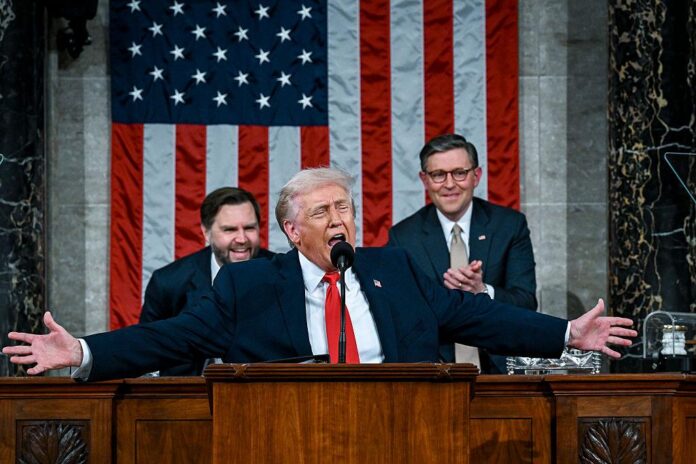
Following his 2026 State of the Union address, President Donald Trump is continuing to press his economic agenda, emphasizing tariffs, tax policy, and domestic manufacturing as pillars of national growth. According to reporting from the Associated Press, the administration is framing its economic doctrine as a strategy designed to prioritize American industry, reduce trade imbalances, and stimulate investment at home.
In his remarks, Trump highlighted recent tariff adjustments and ongoing efforts to reshape trade relationships. The administration argues that strategic import duties encourage domestic production and reduce dependency on foreign supply chains. By pairing trade enforcement with tax competitiveness and regulatory streamlining, officials say the goal is to create an environment that attracts capital investment and supports long‑term industrial expansion.
Economic data released in recent weeks has shown continued resilience in consumer spending and manufacturing investment. Supporters of the administration’s approach point to these indicators as evidence that assertive trade policy has not stalled growth. Instead, they argue, tariffs function as leverage in negotiations while reinforcing supply‑chain security and production stability.
Critics, however, caution that tariffs can raise costs for import‑dependent businesses and potentially contribute to price pressures. The debate centers on whether trade barriers ultimately strengthen domestic production or create offsetting economic friction. Administration officials maintain that calibrated implementation and strategic exemptions help mitigate potential inflationary effects.
Politically, the post‑address messaging underscores a consistent theme: economic sovereignty through domestic production. The White House continues to highlight reshoring initiatives, energy expansion, and infrastructure investment as complementary components of the broader economic framework. By presenting tariffs as part of a coordinated industrial policy rather than isolated measures, the administration seeks to reinforce coherence in its strategy.
Financial markets have responded with measured attention rather than volatility. Investors appear focused on execution details and legislative developments rather than rhetoric alone. Clear statutory grounding for tariff actions and predictable policy timelines are central to maintaining business confidence.
Geopolitically, the administration’s economic emphasis may influence ongoing negotiations with major trading partners. Trade measures often serve dual roles — economic tools and diplomatic signals. By reaffirming tariff policy following the State of the Union, the administration signals that trade leverage remains active in shaping international discussions.
The speech also sought to position economic policy within a broader national security framework. Domestic manufacturing capacity, particularly in strategic sectors such as technology and energy, is framed as essential to long‑term resilience. Supporters argue that strengthening industrial capacity reduces vulnerability to global disruptions and enhances bargaining power.
Congressional response will likely determine how much of the agenda transitions into codified legislation. Some lawmakers have expressed support for clearer tariff authority and expanded incentives for domestic investment. Others have called for increased oversight or targeted adjustments to trade statutes. The coming months may reveal whether bipartisan consensus emerges on select elements of industrial policy.
Ultimately, the administration’s message remains consistent: trade enforcement and domestic production are central to economic competitiveness. The State of the Union served as a high‑visibility platform to reinforce that narrative, and post‑speech messaging indicates sustained momentum rather than recalibration.
Why It Matters
Economic policy direction influences investment, supply chains, and consumer confidence. By reaffirming tariffs and domestic production as strategic priorities, the administration signals continuity in its growth model.
For businesses and markets, clarity around trade and tax policy reduces uncertainty and informs long‑term planning. The balance between leverage and stability will shape investor sentiment.
Political & Geopolitical Implications
Politically, the renewed emphasis strengthens campaign messaging centered on economic independence and manufacturing revitalization. Legislative engagement may intensify as lawmakers debate trade authority and industrial incentives.
Geopolitically, sustained tariff signaling affects global negotiation dynamics. Trade partners will assess whether current policies represent long‑term structure or tactical positioning within broader economic talks.
Implications
The administration’s post‑State of the Union push underscores persistence in its trade‑driven economic approach. By pairing tariffs with tax and industrial policy themes, the White House aims to project strategic coherence. The effectiveness of the approach will depend on legal durability, legislative support, and international response.
