Story Highlights
- The president disclosed that a covert Secret Service operation in July transported him via a C-32A aircraft instead of the standard Air Force One following a credible Iranian assassination threat
- His administration asserts that security personnel and military advisors determined the alternative flight presented equivalent safety measures while reducing risk to the chief executive
- The president emphasized that consequential leaders face numerous threats requiring protective measures that may not be publicly disclosed in real time
- The operation remained compartmentalized, with journalists and White House staff aboard the decoy aircraft unaware of the presidential switch
What Happened
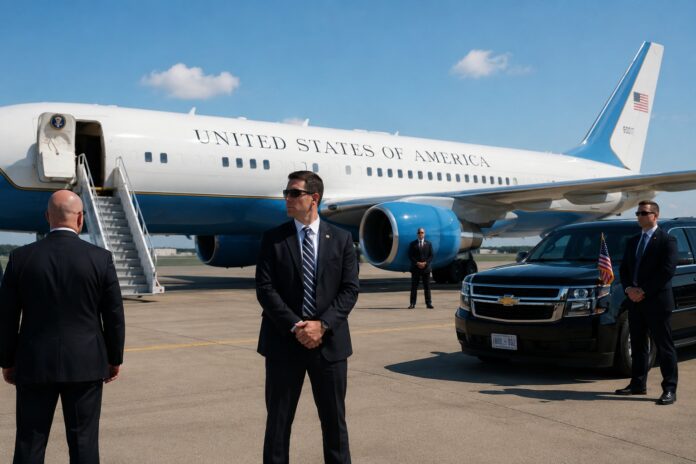
A classified security operation conducted in July involved the Secret Service and military personnel transporting the president via an alternative Air Force C-32A aircraft rather than the standard Air Force One after receiving intelligence regarding a potential Iranian assassination plot. The operation maintained strict operational security, with only a select number of individuals informed of the presidential movement. Journalists and White House staff members aboard the decoy aircraft remained unaware that the president had transferred to a different flight, believing throughout their journey that they were traveling with the chief executive.
The Washington Post revealed the operation this week, prompting the president to address the matter at Joint Base Andrews, Maryland, following his return from the Patriot Games in Ohio. When asked about the security measure, he explained that his administration follows guidance from Secret Service and military leadership regarding protective measures. The president characterized the switch as a precautionary decision based on threat assessments rather than an extraordinary measure, noting that consequential leaders routinely face security challenges requiring unconventional responses.
- Covert operation occurred in July 2024 following Iranian assassination threat intelligence
- President transferred via catering vehicle to C-32A aircraft while decoy plane carried press and staff
- Washington Post revealed classified operation details this week
- Presidential explanation given at Joint Base Andrews following Patriot Games event
Why It Matters
The incident underscores the significant security challenges facing the current administration and the extraordinary protective measures required for a sitting president facing documented foreign threats. The president’s defense of the operation emphasizes that national leadership necessitates security protocols that may appear unconventional to the public but represent standard practice for chief executives managing credible assassination plots. His assertion that consequential presidents attract substantially more threats than their less impactful counterparts reflects the reality that prominent executives implementing significant policy changes become targets for hostile actors.
The operation also demonstrates the delicate balance between operational security and transparency, with the White House prioritizing protection measures over immediate public disclosure. The president indicated that his administration defers to security experts and military advisors regarding protective decisions, suggesting that such measures reflect professional threat assessments rather than arbitrary actions. This framework positions security decisions as apolitical judgments made by trained professionals rather than political theater.
- Foreign threats against sitting president require sophisticated security responses beyond standard protocols
- Operational security decisions affect press access, staff awareness, and public transparency regarding presidential movements
- Security measures impact confidence in Air Force One as reliable transportation for large delegations including journalists
- Presidential defense of protective measures establishes precedent for future security operations during his administration
Political and Public Context
The operation occurred within a broader context of heightened international tensions and documented threats against American leadership. Iranian officials have previously articulated hostile intentions toward the current administration following significant policy decisions affecting their interests. The intelligence community’s assessment of credible assassination threats reflects genuine security concerns rather than speculative scenarios, justifying the extraordinary measures undertaken by protective services.
The president’s characterization of his consequential status has precedent in historical analysis of executive impact. Leaders who implement transformative policies inevitably attract opposition from actors opposing their agenda, both domestically and internationally. The assertion that consequential presidents face disproportionately higher threat levels than their predecessors reflects documented patterns in presidential security, where threat levels correlate directly with the significance of policy initiatives undertaken by individual administrations.
- Iranian regime has articulated hostile intentions toward current presidential administration
- Threat assessments conducted by intelligence agencies determined credible assassination plots
- Security protocols for sitting presidents have evolved significantly following various historical incidents
- Presidential security operations remain largely classified due to operational security requirements
The New York Times reports a serious Ankara threat prompted the Secret Service to secretly move Trump off Air Force One in a catering container onto another military aircraft. Air Force One then departed for Britain with senior officials and military per… pic.twitter.com/McmVoiJRuz
— Drew Grimaldi (@Grimillionaire) August 12, 2026
What Happens Next
The revelation of the covert operation establishes precedent for future security measures undertaken by the White House during the remainder of the presidential term. The Secret Service and military leadership will likely implement additional protective protocols based on ongoing threat assessments, with continued deference to professional security guidance informing presidential movement decisions. The president has signaled that his administration will prioritize protection measures over real-time transparency when security professionals determine such measures necessary.
Future operations will likely maintain similar compartmentalization to preserve operational effectiveness and prevent hostile actors from obtaining information regarding presidential protective measures. The incident demonstrates that the current administration prioritizes protection of the chief executive above other considerations, including press access and staff awareness. Ongoing threat assessments will continue informing security protocols throughout the presidential term, with the expectation that protective measures will adapt to evolving intelligence regarding foreign and domestic threats.
- Secret Service will implement additional protective measures based on ongoing threat assessments
- Presidential movement operations will maintain strict compartmentalization for security purposes
- Intelligence community will continue monitoring foreign threats and providing updated assessments to protective services
- White House will likely provide limited transparency regarding future security operations to preserve operational effectiveness