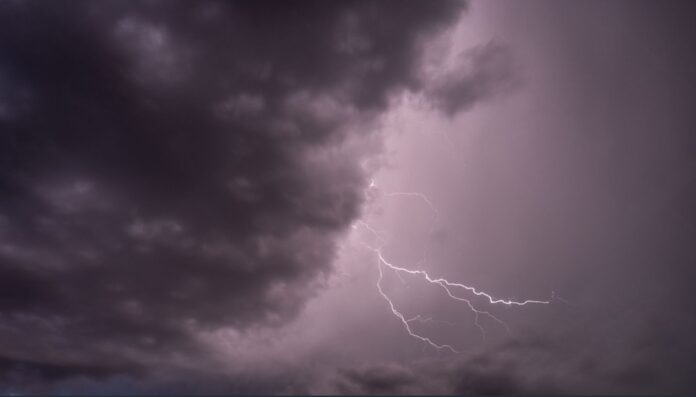
The Longest Lightning Bolt Ever Recorded
In October 2017, the skies over the central United States delivered a spectacular display that still has scientists buzzing. A single lightning flash stretched an astonishing 515 miles (829 kilometers), blazing across five states—from eastern Texas all the way to near Kansas City, Missouri.
This event, officially verified by the World Meteorological Organization (WMO), has been dubbed a “megaflash.” It lasted for nearly seven seconds, making it not just the longest but also one of the most awe-inspiring electrical discharges ever observed.
To put that in perspective: this bolt of lightning was longer than the distance between New York City and Cleveland—all in one strike.
How Scientists Captured It
Traditionally, lightning flashes are studied with ground-based sensors. But this megaflash was so vast that only advanced satellites—like NOAA’s GOES-16 and GOES-17—could fully map it.
Why Megaflashes Matter
Megaflashes aren’t your average thunderstorm bolts. They form in massive mesoscale convective systems—giant storm complexes that can stretch across several states and last for hours.
Because these flashes extend hundreds of miles, they sometimes strike unexpectedly far from the parent storm. This phenomenon, known as a “bolt from the gray,” can catch people off guard since it happens under skies that may appear calm.
Risks include:
- Aviation safety – Planes flying near storms face unexpected lightning threats.
- Wildfires – A strike miles away from rainfall can ignite dry vegetation.
- Public safety – Outdoor events and rural communities are especially vulnerable.
The rarity of such megaflashes—estimated to occur in fewer than 1% of thunderstorms—makes them fascinating, but also harder to predict.
These satellites carry sophisticated Geostationary Lightning Mappers (GLMs) that detect the faint optical signals produced when lightning occurs above the clouds. Paired with ground sensors, scientists were able to reconstruct the path of the flash in millisecond detail.
Dr. Randall Cerveny, a WMO rapporteur, described it as “a breathtaking reminder of how powerful our atmosphere can be—and how much more we still have to learn about it.”
The Push for Better Warnings
The WMO has been urging global adoption of its “Early Warnings for All” initiative, which aims to provide stronger storm and lightning alerts by 2027. By documenting record-setting events like this, scientists hope to:
- Refine predictive storm models.
- Improve early-warning systems.
- Protect communities, aircraft, and power infrastructure from the hidden dangers of megaflashes.
In other words, this lightning strike wasn’t just a scientific curiosity—it’s a case study that could save lives in the future.