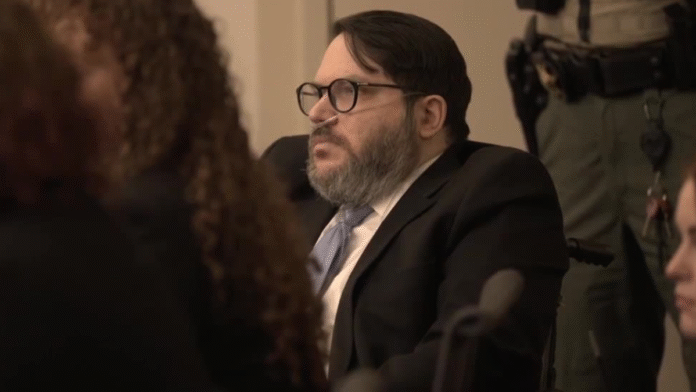
In a courtroom in Salt Lake County, Utah, an extraordinary trial is underway. Nicholas Rossi, a fugitive accused of rape, fraud, and even faking his own death, is facing justice after years of international evasion. The case, which stretches across multiple states and countries, has become a striking example of how global mobility and identity fraud collide with law enforcement.
A Life of Aliases
Rossi, also known as Nicholas Alahverdian and Arthur Knight, allegedly attempted to escape accountability by fabricating his own death in 2020. Prosecutors claim he staged his demise, then fled to Scotland, where he lived under assumed identities until his arrest.
When Scottish authorities discovered inconsistencies in his records, Rossi was detained and later extradited to the United States.
The Charges
The Utah trial centers on allegations of rape, but prosecutors also argue that Rossi’s elaborate deception demonstrates a pattern of manipulation. They claim his history of aliases and fabricated documentation shows a deliberate effort to avoid justice.
Prosecutors have tied evidence from Rhode Island, Ohio, and Massachusetts to build a picture of consistent misconduct across multiple jurisdictions.
Defense Strategy
Rossi’s legal team disputes the charges, arguing this is a case of mistaken identity. They claim the man in court is not Rossi at all, but someone else entirely, with medical records and documents supposedly backing their argument.
Their defense hinges on raising reasonable doubt over whether the state can definitively prove the man standing trial is the same person accused years earlier.
Prosecution’s Approach
To counter, prosecutors are focusing on:
The alleged victim’s testimony, presented at the trial’s opening.
Travel and communication records linking Rossi to multiple incidents.
Alias evidence, which they argue Rossi used to obscure his trail.
They contend that Rossi’s identity fraud was not an accident but a calculated scheme to evade accountability for sexual assault.
International Dimension
The case also highlights the complexity of cross-border law enforcement. Evidence gathered abroad must be authenticated under U.S. legal standards, creating challenges for prosecutors. But the successful extradition demonstrates the growing cooperation between international law enforcement agencies in tackling fugitives.
https://x.com/BBCScotlandNews/status/1828654273459278123
What’s at Stake
Legal experts say the outcome could influence how courts handle future cases involving identity fraud, extradition, and international fugitives. A conviction would show that elaborate attempts to fake death and assume new identities cannot shield someone from justice.
An acquittal, however, could raise serious concerns about the reliability of evidence spanning multiple countries and jurisdictions.
Public Fascination
The case has captured public imagination due to its bizarre twists—a fugitive pretending to be dead, resurfacing in another country under a different name, and ultimately dragged back to stand trial. For many, it feels like a true-crime thriller unfolding in real time.
Final Thoughts
The Nicholas Rossi trial is about more than one man’s guilt or innocence. It is a test of how effectively justice systems can adapt to identity fraud and international fugitives in an age of global mobility.
Whether Rossi is convicted or acquitted, the case underscores the reality that in today’s interconnected world, faking your death is no guarantee of escaping accountability.