Story Highlights
New data shows continued gains in U.S. manufacturing investment.
Trump campaign highlights factory expansion and capital spending growth.
Domestic production remains central to economic messaging.
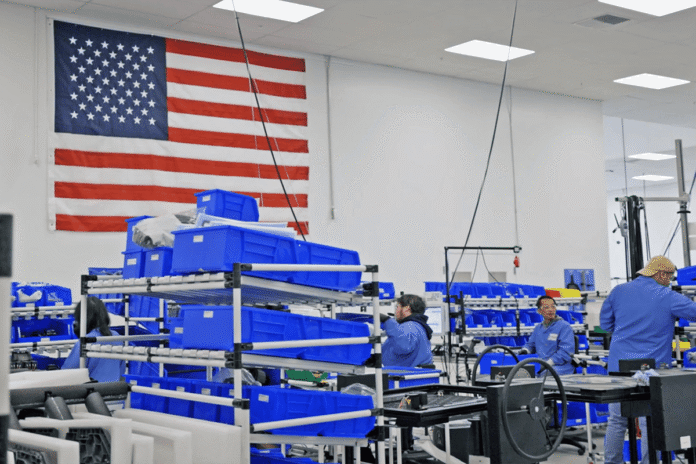
President **Donald Trump’s campaign highlighted newly released economic figures showing sustained growth in U.S. manufacturing investment and factory expansion. The data, reported by Bloomberg, reflects ongoing capital expenditure in industrial equipment, plant construction, and advanced production facilities across multiple states. Campaign officials framed the numbers as evidence that policies promoting domestic industry are delivering measurable results.
Manufacturing has become a focal point in broader economic strategy, particularly in sectors tied to semiconductors, heavy equipment, automotive production, and advanced materials. Increased investment often signals confidence among corporations in long‑term demand and regulatory stability. Economists note that manufacturing spending can have multiplier effects, supporting jobs not only in factories but also in logistics, engineering, and supplier networks.
The latest figures suggest that companies continue allocating resources toward domestic facilities, even amid global supply chain recalibration. Over recent years, firms have sought to diversify production footprints to mitigate geopolitical and logistical risk. Strengthening U.S.-based manufacturing capacity aligns with that trend, reinforcing resilience in critical sectors.
From a labor market perspective, manufacturing expansion can contribute to wage growth and regional economic revitalization. Many projects involve modernization and automation, increasing productivity alongside employment opportunities in skilled trades. State governments often compete for such investments, offering incentives tied to infrastructure and workforce development.
Financial markets tend to view manufacturing growth as a positive indicator of economic momentum. Capital expenditure often reflects long‑term corporate planning rather than short‑term fluctuations. Sustained investment can signal optimism about demand conditions and industrial competitiveness.
Politically, the emphasis on manufacturing aligns with long‑standing messaging around reshoring production and reducing reliance on foreign supply chains. Supporters argue that strengthening domestic industry enhances national security and economic sovereignty. Critics sometimes question sustainability and cost efficiency, but the headline data underscores continued capital flow into U.S. production facilities.
The global context remains important. Industrial competition increasingly intersects with strategic priorities, including technology leadership and infrastructure development. Countries worldwide are investing heavily in domestic production capacity, particularly in advanced sectors. Maintaining momentum in U.S. manufacturing may shape competitive positioning in emerging technologies.
Looking ahead, analysts will monitor whether investment trends translate into sustained output gains and export growth. Manufacturing activity often fluctuates with broader economic cycles, making consistency a key indicator. If current trends continue, the sector could remain a central contributor to economic performance over the coming quarters.
Why It Matters
Manufacturing investment influences employment, productivity, and trade balances. Strong capital expenditure suggests confidence in domestic economic conditions. For policymakers, steady factory expansion supports arguments that pro‑industry frameworks can drive tangible outcomes.
Industrial growth also strengthens supply chain resilience. Domestic production capacity reduces exposure to international disruptions and enhances flexibility in strategic sectors.
Political & Geopolitical Implications
Politically, the data reinforces campaign narratives emphasizing economic strength and domestic industry revival. Lawmakers may debate additional incentives to sustain growth, particularly in high‑tech and infrastructure‑linked manufacturing.
Geopolitically, expanding U.S. production capacity can alter trade flows and competitive dynamics. Greater output in advanced sectors may strengthen America’s leverage in economic negotiations and global industrial policy discussions.
Implications
If sustained, current manufacturing investment trends could contribute to broader economic stability and competitiveness. The long‑term impact will depend on demand conditions, workforce readiness, and continued capital deployment. For now, the data highlights industrial expansion as a key economic theme.
Sources