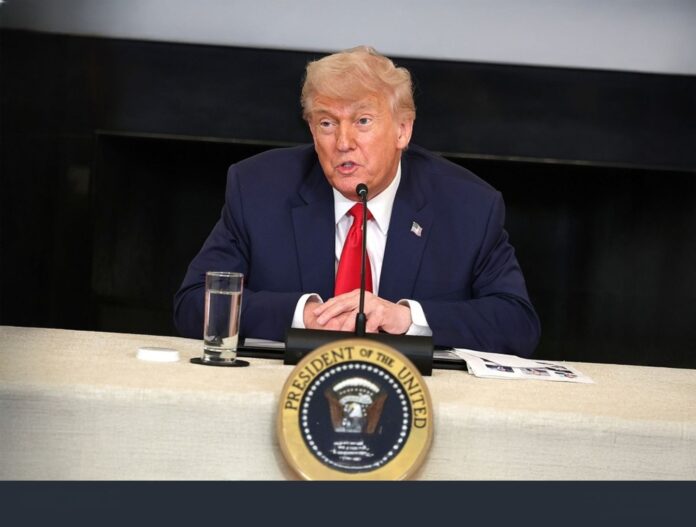
President Donald Trump issued a blunt warning toward Venezuelan leader Nicolás Maduro during a briefing at the White House, stating that Maduro “doesn’t want to f-around” with the United States as tensions escalate over covert disruptions to the regime’s security and financial networks. The remarks came days after Washington authorized expanded CIA operations and increased maritime interdictions targeting Venezuelan drug-smuggling vessels in the Caribbean.
Story Highlights
- Trump delivers direct public warning to Maduro amid covert pressure campaign
- Remarks follow new U.S. intelligence and maritime operations against Venezuela
- Caracas denounces U.S. posture as “hybrid warfare” and vows retaliation
- Analysts see escalation as calibrated deterrence rather than open confrontation
Escalation by Messaging, Not Mobilization
While Trump did not announce new sanctions or troop deployments, the public tone represents a shift from quiet intelligence activity to overt deterrence signaling. Administration officials describe the objective as “controlled coercion”—forcing internal stress on the Maduro government without triggering open conflict or U.S. force projection.
Treasury and intelligence sources confirm that parallel financial disruptions are targeting offshore accounts and crypto channels used by Venezuelan officials to bypass existing sanctions frameworks. These actions follow the classified directive authorizing “precision destabilization” measures against the regime’s support architecture.
Caracas has condemned the moves as “war by other means,” while simultaneously reinforcing domestic counter-intelligence controls.
Regional and Strategic Dimension
Colombia and Panama have expanded cooperation with U.S. agencies, contributing logistics and surveillance as part of a broader regional containment effort. Brazil has taken a more cautious posture—publicly neutral, privately cooperative on data-sharing tied to cross-border smuggling networks.
European governments have not endorsed the escalation but have refrained from criticism, indicating a perception that U.S. action may succeed where prior diplomacy stalled. Russia’s call for a U.N. Security Council session underscores that the information war around Venezuela is now international, not merely hemispheric.
Analysts at multiple policy institutes emphasize that the U.S. is testing a “deterrence without deployment” model—projecting power through intelligence, finance, and signaling rather than expeditionary force.
Political and Legal Exposure
The approach carries risks of blowback if U.S. involvement is exposed operationally or if covert actions generate civilian or regime-allied casualties. Congressional critics warn of “unchecked clandestine escalation” outside formal war authorization frameworks.
The White House positions the strategy as legally anchored in counter-narcotics and national-security authorities and argues that “inaction would entrench a criminal state on the U.S. doorstep.” Courts are considered unlikely to intervene absent a concrete harms claim.
Forward Outlook
If Maduro sustains pressure without concessions, Washington may escalate to secondary sanctions on entities facilitating Venezuelan oil routing through Asia and the Gulf. Conversely, if internal fractures appear inside Venezuela’s military or security ranks, the U.S. may attempt to broker a transitional amnesty agreement to accelerate regime collapse without force.
For now, the administration’s posture suggests that Venezuela has entered a long horizon of managed coercion—slow, cumulative, and deliberately asymmetric.
Sources
Reuters • U.S. Treasury briefings • Latin American security officials • Policy analyst commentary • White House press pool