What Happened
After nearly two years of relentless conflict, President Donald Trump announced that the Gaza war is officially over. Speaking from the White House Rose Garden, Trump confirmed that the final hostages held by Hamas were released under a U.S.-brokered agreement involving Egypt, Turkey, and Qatar.
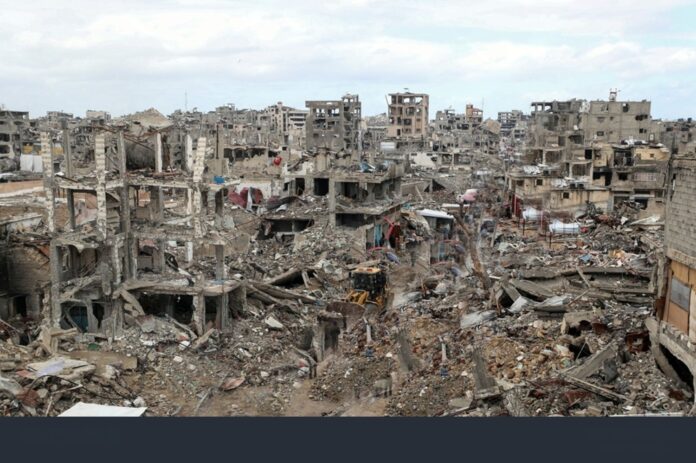
The historic cease-fire brings a fragile calm to a region that has endured more than 700 days of devastation. Under the terms, Israel agreed to halt all offensive operations, Hamas consented to a verified disarmament process supervised by Egyptian mediators, and reconstruction efforts will begin within weeks.
Trump signed the Tripartite Peace Implementation Framework, the document that cements U.S. oversight of prisoner exchanges, humanitarian corridors, and post-war aid distribution. In his words:
“This deal shows that peace through strength still works. We didn’t just stop a war — we ended one.”
For the first time since hostilities erupted, both Israeli and Palestinian representatives attended the same press briefing in Cairo, a symbolic step toward normalization.
Why It Matters
The announcement marks Trump’s most consequential foreign-policy achievement since the Abraham Accords. By pushing through last-minute talks with Netanyahu and leveraging regional ties with Egypt and Qatar, the administration achieved what international diplomats deemed impossible — a total cessation of hostilities with mutual recognition of sovereignty zones.
Beyond the Middle East, the move is expected to reshape U.S. credibility as a peace broker. After years of skepticism toward Washington’s role in the region, Trump’s strategy—rooted in hard leverage, rapid negotiation, and military deterrence—has reasserted American influence.
Economic analysts note that a lasting cease-fire could stabilize global oil prices and reduce shipping risks through the Suez Canal. Defense markets reacted immediately: U.S. energy and aerospace stocks climbed 1.8 percent within hours of the announcement.
Most importantly, thousands of civilians on both sides will now receive humanitarian aid. The U.N. Relief Agency confirmed over $2 billion in pledged assistance, with U.S. logistics teams coordinating delivery from Cyprus and Alexandria.
Reactions
Israeli response:
Prime Minister Netanyahu hailed Trump’s persistence, saying, “President Trump’s leadership was critical. He stood firm for Israel’s security while pursuing peace.” Conservative factions in the Knesset, however, warned that Hamas must fully comply with the disarmament clause before normalization can proceed.
Palestinian response:
Hamas officials publicly thanked Egypt and Qatar for their mediation but indirectly acknowledged U.S. involvement. Crowds in Gaza City gathered chanting “the siege is over” while border crossings reopened for the first time in months.
U.S. and global reaction:
The United Nations Secretary-General praised the accord as “a rare moment of unity in a divided world.” Meanwhile, European leaders, including France’s Emmanuel Macron and Germany’s Olaf Scholz, credited Trump’s “unconventional diplomacy” for breaking the stalemate.
Critics in Washington’s opposition benches attempted to downplay the deal, calling it “politically timed.” Yet independent analysts across the Atlantic Council and Brookings Institution acknowledge that Trump’s approach produced tangible results—something years of multilateral diplomacy failed to achieve.
What’s Next
Implementation remains the true test. A Joint Security Commission, chaired by U.S., Egyptian, and Israeli officials, will monitor compliance for the next 12 months. Reconstruction of northern Gaza’s hospitals, power plants, and schools begins within weeks, funded by a multinational coalition led by the U.S. Development Finance Corporation.
Trump has hinted at a “Middle East Stability Summit” later this year to expand economic cooperation and ensure peace dividends reach ordinary citizens. The broader goal: anchor the cease-fire within a new “Prosperity Corridor” linking Israel, Gaza, and Jordan for trade and infrastructure.
For Trump, the moment reinforces his campaign message that “peace through strength” still defines American leadership. Supporters view this as vindication of his transactional, results-first style—one that blends diplomacy with firm negotiation and visible accountability.
Sources
Reuters | Associated Press | Al-Monitor | Jerusalem Post | White House Press Office